Saturday, March 2, 2013

On the Boundaries of Civilization...

Last weekend saw another trip out west, not as far as Havasu and the whole different panoply of awesome birding that is to be had there, but to the barren, desolate intersection of the Salome Highway and Baseline Road out in Buckeye, also known as the Thrasher Spot (and, apparently, a great place to ditch old couches and other household items, despite the seeming inconvenience of driving them out and dumping them in the middle of nowhere).
This is one of my favorite 'within-an-hour-of-home' spots in Maricopa County, as it features some special birds not commonly found elsewhere in the state, it's a relatively small area, and it doesn't require that I look up into big trees. 

As this point in the year, the creosote and sage scrub hosts inordinate numbers of migrating Sage Thrashers, along with Sage Sparrows and the more elusive, more sought after Le Conte's and Crissal Thrasher. There are Bendire's Thrashers out there too, but oddly enough the region is too arid for the more common Curve-billed Thrashers found just about everywhere else. 

From behind, the Sage Thrasher can be easily confused with a Mockingbird, but once visible, the speckled breast is unmistakable, even at a distance. Plus, Phoenix-area Mockingbirds are too smart and spoiled to live out here in the boonies. 


Along with Sage, Bendire's are the most visible Thrashers at the site, as they're more comfortable and more inclined to perch high and sing even with the attention of people, and on this day there were even a few Audubon groups moseying out and about in the chaparral.


Crissal and Le Conte's usually stay low the the ground, but even so I've had excellent luck finding Le Conte's lately. About fifty or sixty yards west of the parking area along the Salmoe highway there is an old wash running north/south. Following this wash north to where it intersects with a line of old rotten fence posts yields an area that is frequented by the ghostly, vampiric-looking Le Conte's Thrasher.


Unfortunately I was unable to keep a bead on these crafty birds long enough to share them with a family trio of birders nearby, but soon after we all linked up with fellow birder, photographer, and tall person Gordon Karre, with whom we enjoyed the other birds in the area, including Gnatcatchers, Verdins, and the beautiful Sage Sparrows. As things started to simmer down at the Thrasher Spot we all made a caravan and checked out some of the Arlington area attractions, including a single Long-billed Curlew and some tardy Sandhill Cranes still lingering in the fields. 

As the Sandhill Cranes flew off and we parted ways, I decided to trade one extreme for another, and on the way back from the desiccated Thrasher spot and the bucolic Arlington pastures, I swung by the Crystal Gardens community on 107th avenue and the I-10. 
This master-planned community has a series of scenic ponds and pathways connecting the manicured neighborhoods, and these water features have hosted a number of attractive (and, for that matter, un- attractive) Geese this winter. Arizona birder and blogger extraordinaire Tommy DeBardeleben had recorded Greater White-fronted, Ross's, Snow, and Cackling (also, of course, Canada) all at these ponds, along with a single Tundra Swan, in early February. In mid-February I was able to find most of the birds but did not get satisfactory photos, in large part due to the limited amount of time I had to spend at the site. 


Returning now with new grit and determination, some of the dispersed Geese afforded very close and comparative views, like the Lesser and Greater subspecies of Canada Geese above. There were plenty of ornamented Canada in the cozy lakes, but finding a small and cackling goose proved difficult.


Diminutive individuals like this lesser Canada Goose exacerbated the problem, and ultimately I resigned myself to the probability that the Cackling Goose, which had gone missing from eBird reports for the last week, was likely moved out of the suburbs. Though charmingly smaller and quieter than the normal Canada Goose, the Lesser subspecies is still poor consolation.


The Cackling Goose thus remained a photo-nemesis, but the Ross's Geese seemed to have increased in number since my last visit. Even as I parked there were five flying overhead, and there were several more floating in some of the centrally located Crystal Garden Ponds. 


This is a species I'm used to picking out of dozens and dozens (at least) of Snow Geese. It was peculiar and pleasing to find this cute little Goose in groups of its own, with the hideously grinning and grating Snow Geese nowhere to be seen. 


Seagull Steve over in California argues that Ross's are the cutest Geese around town. After getting to spend some more time with these mild-mannered snowhites, I think he may be right.


Going from arid scrub desert to lush city parks was a nice, yin-yang kinda circle to the day. It combined uncommon resident birds with uncommon vagrants, and of course plenty of cool and common birds in between. It's hard to wander in any direction around Maricopa County and not to stumble across a great birding spot or two.

Tuesday, February 26, 2013

Back to Basics

The last several posts have featured either the frozen tundra that is Iowa in winter or some of the singular vagrants that have turned up around Phoenix this winter. Given the combination feelings of  cold and strange that those themes can bring, it's been nice lately to indulge in some of the warmer, more familiar places and faces around Phoenix. 
The Papago Ponds between Phoenix and Tempe host plenty of winterfowl, along with the year's first Swallows. The ponds aren't deep or wide enough to attract Goldeneye and Buffleheads, but for photographing Pintails, Wigeons, Ring-neckes, and even Canvasbacks, there's no place better. 


As far as waterfowl goes, these ducks are all pretty plebian. That doesn't mean they're not gorgeous.


I admit, on my weekend birding expeditions now I often skip over the waterfowl if I've seen them before. Time is precious and the winter months bring so many other attractions to in Arizona. Every now and again it is very nice to make a specific point simply of visiting again with these docile and beautiful birds, in no small thanks to the fact that, compared to vagrant Warblers ethereal Kites, they're really accommodating subjects for observation and photography.


In addition to the predictable and silly palm trees, there are lots of low-lying, now leafless scrub trees around the ponds, and these provide excellent viewing points for the expected desert birds. Some are boring, common, and even slightly deformed.


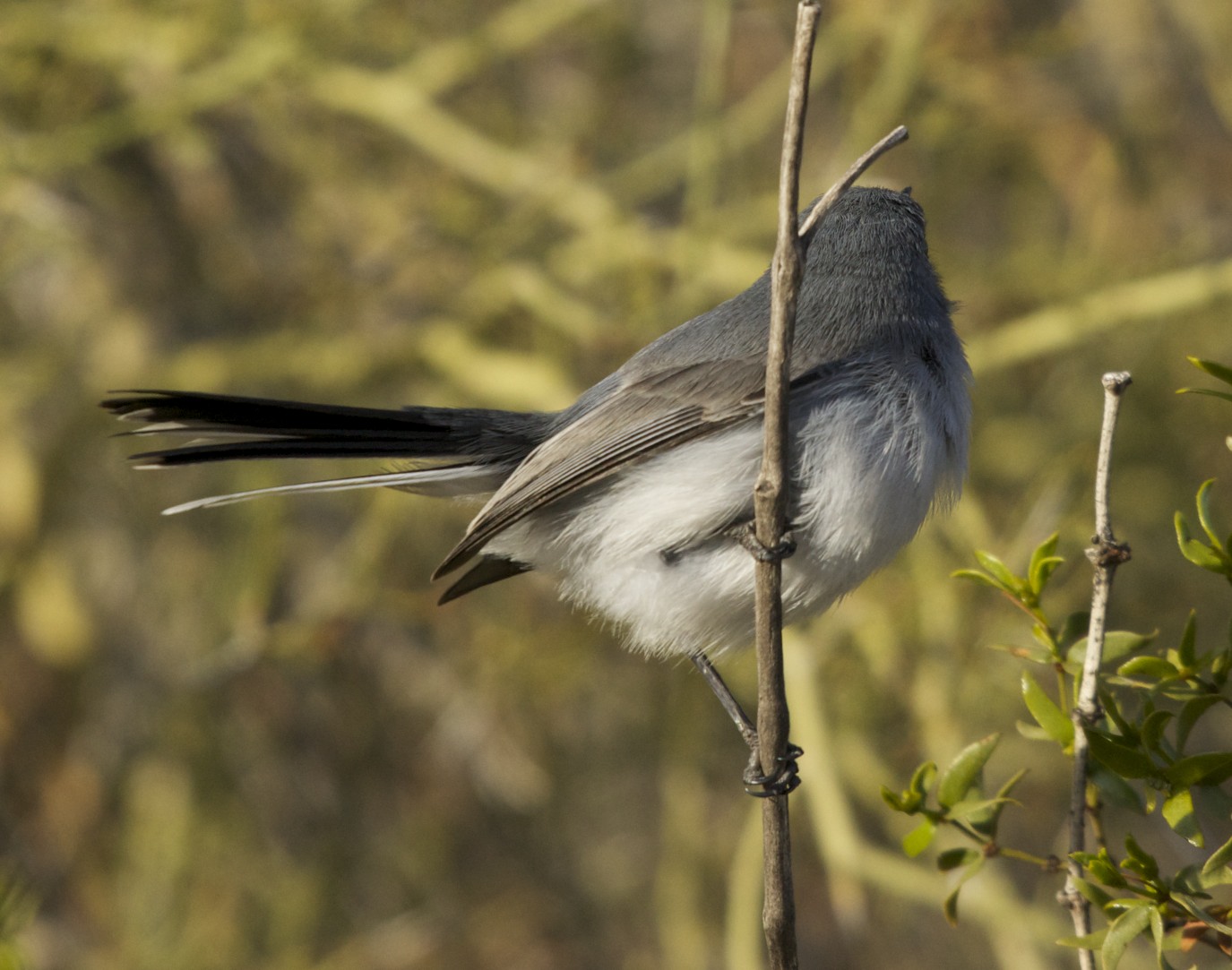
Some are still pretty common, like this Blue-gray Gnatcatcher, but are much more fun. These birds are already operating in couple throughout the Papago creosote patches. They don't mind people getting up close and personal, but they don't sit still either, so it's a fair trade. 


The short vegetation also provides welcome perches for Northern-rough Wing Swallows. While these Swallows won't win the 'Most Colorful Swallow' award, they do win the punctuality award in Phoenix for being the first Swallows back in town, usually by mid-February. 
The Papago mesquites are some of the best places to see these guys perch and preen. The namesake rough out coverts/shoulder on the bird's wings are even somewhat visible here.


 It's not often that a Swallow stops to take a break, but when the bugs are abundant and the weather is mild, there's no hurry. Sometimes I feel exhausted just watching them dip and dive all day (in fact, it's so exhausting, I've never even watched a Swallow all day); it must be nice for them to have a breather.


As one might expect of such ebullient aviators, they're also prodigious eaters. It's hard for scientists to estimate how many things these acrobatic Swallows kill and eat in their lifetime--far more than any Raptor or Tern--but at least from the small, flying insect perspective, this round fluffy head, with its vacant expression and stubby bill, is neither cute nor endearing, but is in fact the head of a mass murderer..bum...Bum...BUM!

Monday, February 25, 2013

Ivy League Birding: Princeton W.A.

It is a lesser known and celebrated fact that the prestigious Princeton College in New Jersey actually is named after a wildlife refuge in eastern Iowa. Of course, most things in the northeast are actually named after obscure midwestern wildlife refuges. This refuge, like the college, has some prestigious and fancy to-do birds. Also like Princeton (honestly, I have no idea) the atmosphere here was bitterly and bitingly cold. The riparian woodlands and the adjacent, off-shooting fingers of the Mississippi provided some flowing water and habitat for those brave wintering waterfowl and other perennial birds. Fanciest of all out sightings was this pair of Trumpeter Swans.


Equally conspicuous, though not due to its size or elegance, was this single Ross's Goose, who was doing its best to stay alive in the rough and tumble world of a Canada Goose Gang.


It is curious to ponder how this single Ross's ended up in this secluded area, without any other Geese of its type. We didn't even see any Snow Geese around. Was he trying to be clever in joining up with this gang, thinking they were one of the groups that would take him to the warm, lush golf courses of Arizona? Did he just get lost or left behind and fall in with the the biggest, loudest, most protecting flock he could find? Are all of the Canada Geese actually his adopted children? Any of these are possibilities.  


The woodlands arounds the Princeton water features did well in hosting the expected winter fare for the area. White-throated and American Tree Sparrows were abundant, despite the frigid wind. In fact, what came across as a frigid wind was probably a simple, cool breeze to the tough-as-nails Tree Sparrows.


Red-bellied Woodpeckers were also numerous, and we even got a lifer Red-headed for me, though it took off before it was possible to take any photos. Still, Red-bellied is a pretty good Woodpecker. It's like the finished version of the similarly but more conservatively capped Gila Woodpecker in the southwest.


We picked up a few Downy Woodpeckers as well, though this male was actually photographed at a different site. From this angle, the bird's head reminds me of a Star Wars stormtrooper, which reminds me that I reference Star Wars really often.


The Swans and Ross's Goose were nice finds and unusual for the area. We picked up some Horned Larks on the way out just to add some yellow to the day's color palette, and saw plenty of Kestrels and Red-tails perched along the drive home. So yes, no big deal but now I've birded my way through Princeton. I'll be expecting big grants and offers from the Cornell Ornithology School any day now...

Friday, February 22, 2013

New Birds in Old Places

These last few weeks I've been forcibly trying to bird more on workdays. After school, I usually have about an hour and a half of good daylight, and even though rush hour (it's not just an hour...) traffic is always a bother, I've been able to fit in some brief but good birding throughout these last few weeks. Often times I leave the camera in the car, in part because I often run out of the necessary time and light needed to pursue photos, and also because there's something refreshing about not having any of the anxieties that come with missing a good shot or making sure to come away with some good photos for one's trouble. 
As such, I've been able to get a lot more birding in this 2013 year and see a lot more birds sooner than I have before. I'd be lying if I said that seeing my name so low in the eBird species lists after January wasn't a substantial motivating factor, but of course the satisfaction and refreshment of birding is reward and motivation in and of itself. One of my recent destinations, which is fortunately nearby, was the Rio Salado/Salt River Audubon Center on Central Ave. 


For being only ten or fifteen minutes south of the downtown (Phoenix is weird like that), this Audubon center is very nice and sits on a pretty piece of property overlooking the Salt River. This site hosts the monthly Birds and Beer get-together and, equally fun, has also hosted a Pacific Wren and Eastern Phoebe this winter. The birds themselves hang out about a half-mile away from the center, down near the trickling water. I used to go birding here quite often before I moved farther away, as it was one of the best places to see Black-throated Grey Warblers and Green-tailed Towhees in Phoenix. 

In addition to the lessened proximity, another one of the reasons I had stopped birding near this center/along this portion of the Salt River was that it's totally trashed. I've had some unpleasant run-ins with vagrants down in the Salt River wash, and the riverbed is strewn with garbage. 


Traipsing through this materialist quagmire, I was constantly looking over my shoulder for a large, one-eyed squid monster to pop out and grab me. You know, like the one living in the garbage compactor in the Star Wars movie? The accumulated trash stretches for miles along the river. It's bad in part because there are seldom any organized cleanups  here and this is where the Salt River dumps everything out, from old frisbees to plastic bottles, car parts, and 1990s-style sneakers (which is also why there's less demand to clean here than where people actually go fishing and tubing farther east).


The area wasn't exceptionally birdy--I only had the usual Herons, along with Orange-crowned and Yellow-rumped Warblers and Black Phoebes for company--but the whole trek paid off when I spotted a conspicuously white-breasted Phoebe in the willows about half a mile west of the central avenue overpass (in the river bed). 


The Eastern Phoebe, a rare but regular vagrant to Arizona in the winter months, only stayed visible for a few minutes before it flew farther west. I had a hard time following the bird as I was looking into the sun, which was also reflecting off the water to form a dual-effect solar blind. I felt like I had to thread the needle, shooting manually through all the willow twigs, but given how short a time I had with the bird it was a very satisfying sighting. It wasn't a lifer, but it was my first Eastern Phoebe in Arizona.


Heading back towards the Audubon center I heard the Pacific Wren vocalizing a Kinglet-like buzz call and saw the bird very briefly, but being low down in the wash and with the sun falling from the sky, and also this Wren's typical behavior, further photos weren't an option. A handsome Cooper's Hawk served as a great consolation sighting at the end of the walk, and I left the Rio Salado area feeling very glad to have revisited this quintessential desert riparian birding site. 


The Birds and Beer event is hosted every third Thursday of the month. I haven't been yet, but I had a celebratory Sierra Nevada Torpedo IPA at home after this trip, and will try to make it for some hobnobbing next month.

Wednesday, February 20, 2013

Oh So Gullible

I wasn't specifically in Iowa for the birds last weekend, but as any other addict can attest...one manages to fit in some time all the same. Eastern Iowa isn't the birdiest of places in winter. It doesn't benefit (consistently) from the boreal winter species, the Crossbills, Redpolls, Northern Shrikes or Gallinaceous birds. It also loses most of its spring and summer residents, and this ultimately results in a fairly depauperated bird population until later March. 
With the terrestrial bird scene so desolate, the Mississippi River provides one large artery--a life line, if you will--for desperate winter birders. If one is willing to brave the cold and icy wind, there are plenty of Gulls and Waterfowl, along with scores of Bald Eagles, wherever there's still some flowing water. Herring and Ring-billed Gulls make up the vast majority of the Gull population, but Thayer's, Black-backed, and Iceland are also known to mingle in these big noisy groups. When our other birding leads grew cold, the Iowa Voice and I spent time trying to pick some rare individuals out. I do not think we saw any Iceland but we got at least one mature/adult Thayer's, of which I did not get any presentable photos. The shots below feature only Ring-billed and Herring Gulls, but do show some of the multifarious plumage messes with which unfortunate birders must deal. I know that with anything larus, I am very gullible...(that's right, I went there!)


My best bet at photographing a Thayer's Gull came with this immature bird. Adult Herring and Thayer's Gulls look very similar, and the immatures do too. Since I had very little experience to draw upon with Gulls, I had to defer to my Sibley's guide. The guide shows young Thayer's having mottled markings all up the base of the tail, like this bird, but also lighter secondaries and primaries on the wings.  The rump on this bird looked good for Thayer's, but that's a more variable characteristic and the wings indicated a Herring Gull, as was confirmed when I later conferred with some Gull Guys.


The immature Herring Gull below had the standard white rump shown in the Sibley's, and while I never held out hope that it was anything but a Herring, the synchronized pursuit of an opportunistic Ring-billed Gull made for an interesting encounter. 


As the rookie Herring Gull tried to get away with its catch, the Ring-billed matched it wing beat for wing beat, stroke for stroke, pressuring and harrying this greenhorn Gull to drop its lunch. These birds had pretty impressive, if also antagonistic, high-speed synchronization. It would make the Russian and Chinese Olympians envious for sure, and here they were showcasing along the frigid Mississippi. This scene could definitely have used some slow-motion video and a classical music soundtrack.


Above the Mississippi River and the nearby dam there was a massive, swirling cloud of screeching Gulls. Like a large, aggressive school of fish, they'd turn and fluctuate together, riding the currents and looking for any opportunity to feed. Soon after this Herring Gulls made its catch, both it and its pursuer disappeared back into the amorphous larus mass above and, so the extent of my knowledge, were never seen nor heard from again.


So I didn't come away with any conclusive Thayer's or Iceland photos to share, but there was some excitement on the river, more in fact than I was expecting in the inclement conditions. 

Tuesday, February 19, 2013

Breaking the Duck

To break one's duck...I've always liked that British-ism, an idiom meaning someone has done something for the first time. It's awkward; it's nonsensical, and it's also kind of scandalous to use in a conversation about birding. But, as far as the British are concerned, every time we birders see a new bird we're 'breaking that duck'.
Within recording a lifer bird there is another phenomenon, a type of synchronicity many birders have experienced, especially if they see a new bird in the first few years of rookie birding. The phenomenon is that once a bird is finally seen, all the sudden one will see it fairly frequently, or at least unusually frequently given how, up until a point, you had never seen it before. This could simply be because the birder wasn't aware of the bird before or capable of recognizing it, or because they only recently started seeking out the sort of habitats that would support such a bird. Sometimes there isn't much of an explanation.

Last week I saw my first Greater White-fronted Goose, an uncommon migrant, at an old birding haunt in west Phoenix. I birded the heck out of that place but never saw a White-fronted. Finally everything lined up and I got my first, not from lack of effort or knowledge but just from lack of circumstance and luck. While spending the weekend in Iowa, my cousin Mike and I then found another Greater White-fronted Goose in west Davenport, another rare find for the time and place. While scanning hundreds of Canada Geese out on a frozen lake, Mike heard a different vocalization and was able to pick our the conspicuous impostor.


So, I broke my duck last week, and now there's a watershed of White-fronted Geese. I predict I will now see them everywhere always forever.

Sunday, February 17, 2013

Front and Center!

On the way home from the Arlington/Palo Verde agricultural fields last weekend I swung by Encanto Park. With several large duck ponds and an adjacent golf green, Encanto isn't bad for an urban park for urban birding. It was a regular weekend patch for me when I lived closer to it, and I even picked up a few lifers there. Nonetheless, it's one of those places with pretty limited bird diversity, and as can happen with the smaller venues, I eventually outgrew it.

Someday, this pretty Gadwall will outgrow it too.

But a recent listerv report caught my attention and drew me back to the paddle boat ponds and its rafts of waterfowl. Someone reported a Greater white-fronted Goose at Encanto, a somewhat common vagrant but one I had not yet seen. I had always figured that eventually I'd stumble across a White-fronted goose at one point or another, and never made much of a point of chasing this species. This particular bird wasn't my discovery, but now there finally was such a goose in the area!


I was happy to swing by my old stomping grounds and survey the ponds once more, especially since I hadn't picked up my target birds in Arlington, but in honesty I also wasn't overly optimistic about the Goose. I didn't recognize the name of the person (sorry!) who posted to the list, and I knew there were also lots of somewhat similarly colored Chinese Geese at the park. The Chinese Geese normally have a bulbous forehead like Mute Swans, but some specimens, like the fellow below, lack the bulge, and can also have varying white bordering their mandibles. 


When I arrived at the ponds the first birds I saw (after that Gadwall) were some Mallards and then the Chinese Geese, but I only had to wait for a few moments before a conspicuous, smaller goose rounded the pond corner and headed my way. The Greater-white Fronted Goose is much more petite than the Chinese Geese, and of course it lacks the bulging forehead and has much more prominent white on its face, in addition to the softer pink bill. Next to the obnoxious Chinese Geese, the White-fronted was a real charmer. 


Geese certainly aren't known for their shyness, especially around urban parks, and this Goose's close approach made me think that it's probably caught onto the handout system for the park, and has likely been there through the winter, living on welfare.


This bird seemed much smaller than the described twenty-eight inch length in Sibley's. The western and southwestern Alaska subspecies of this goose do tend to be smaller though, and while they usually winter in the Mexican highlands, they do pass over Arizona in their routes, and this fellow might've just decided he'd gone far enough by time he hit Phoenix. He swam back and forth between sun and shade, seemingly very content with his little park and the abundance of easy food and little competition that it brings.


It never exited the pond, unfortunately, and I couldn't see any leg bands through the water. Nonetheless this handsome Goose made for a very pleasant return to Encanto and provided me with an unexpected lifer in the middle of Phoenix and in February. Greater-white Fronted Goose, I salute you!

Friday, February 15, 2013

Follow the link!

I'll play the part of a snooty birding aristocrat this month, and tell tales of wining and winging in southeast AZ, now over at Birding Is Fun.