Wednesday, September 19, 2012

Staying Alive with Irish Ponds

Hello Humans! And anyone else who might be visiting from beyond the stars...

It's been super busy these last few weeks. The opportunities for birding have been scattered few and far between other work and social obligations. Alas, I am not made of the sterner stuff required to endure a perpetual birding weekend. At least the residual glow and satisfaction from my early September Salton Sea trip has kept me alive, aided by some occasional forays to local urban sites.

Last Friday I made it out to the McCormick Ponds in east Phoenix/Scottsdale, hoping to maybe see some early waterfowl or an unusual migrant. The waterfowl have not yet arrived in Phoenix en masse, but the drab fall-plumage warblers are trickling through. I had some decent looks at MacGillivray's and Orange-crowned Warblers around the ponds, and was also happy to see Sparrow activity picking up as well. The McCormick ponds are a great place to see Lincoln's, Brewers, Song, and White-crowned Sparrows in winter. I'm hoping that later this year they'll pull in a vagrant White-throated or Golden-crowned to really put McCormick on the birding map.

There were no range rarities, but a perpetually blurry and intrinsically early White-crowned Sparrow was a noteworthy sighting. I don't know that I've ever seen White-crowneds in Phoenix as early as September 14th before. Even eBird scoffed at my sighting, until I provided a photo that would make Bigfoot proud.


A pair of early Northern Flickers also added to the sense of prematurity around the ponds. I have to keep their images blurred too because they wouldn't sign a legal release for me to use their photos publicly. Bummer.


With lots of overhanging vegetation near water, the McCormick ponds are a pretty good spot for Flycatchers. They pull in summer Kingbirds and are a reliable location for Say's Phoebe, Black Phoebe, and Vermillion Flycatcher year round. It is too bad the top of this Phoebe's nasty pipe isn't brown. It could've matched the bird perfectly.


A Western Wood Pewee produced on my recent trip was a first for the location. He seemed to be gearing up for some flycatching just while the sun was gearing down. This may be one of those rare, purely nocturnal subspecies that hunts with echo-location and night vision goggles.


There is a large population of Great Egret and Herons in the McCormick area, and often times they try to disguise themselves as lawn ornaments on the golf course, you know, like those wire-legged flamingo decorations. They stand for a while and then evacuate their bowels in a very torrid fashion (If you've seen it, you know what I'm talking about!). This must drive the golfers nuts. The thought of them stepping in Egret discharge makes me chuckle every time.


As I was safely disguised as/behind a palm tree, this Egret felt comfortable enough to indulge in a little scruffy fluffy shakin' down.


As mentioned before, one of my goals this winter is to find a nice rarity at the McCormick Ponds. In part this is just to vindicate my trips to the area, as I've never encountered another birder there and do not know that anyone visits these sites anymore. I also feel like, in part for that reason, they're overdue. Even if I dip on the rarity this year, it will not be time poorly spent.

Saturday, September 15, 2012

Pool Skimmers

A few of weeks ago Pops and I drove out to an infamous, festering hole of satan sweat in southeastern California also know as the Salton Sea. It was a great trip jam-packed with new and interesting smells as well as sunburn and, oh yes, some fabulous birding. We saw several new species throughout the day, and among the most impressive and memorable of our sightings was a colony of Black Skimmers at the Wister Waterfowl Management Area. The Wister area was our first birding hotspot of the morning. We saw close to forty species just in that locality, and it was the Skimmers that really got things started in grand style.


As we later found out from a ranger, several hundred Black Skimmers had been using the sandbar islands as a breeding around for the last few years. In doing some research for the trip (like any good bird nerd), I had not read about this breeding colony, so it was with great surprise and enjoyment that we heard about this curious colony of coastal birds who had set up shop some two and a half hours from the Pacific shores. 


While not quite as adept in the air as Terns, Skimmers are still excellent aviators, and they were much more comfortable in the air than walking or standing on their narrow islands with those highly specialized and highly cumbersome mandibles. 


Sporting black backs and solid white bellies, these birds are some of the most formally dressed fisherman one will see around the Salton Sea. Despite their pomp and circumstance, getting close and observing these birds was not without difficulties. Pops and I arrived in the Salton Sea area on September 1st, the first day of dove hinting season. While we walked and drove around the Wister riparian area, the surrounding scrub continually echoed with errant shotgun blasts and bustled with potbellied men in camouflage constantly relocating with their camping stools. Being the only birders in the area and having a desire to get closer to our quarry, we had to keep our heads low as we drove along the Wister dikes, parallel to the Skimmer islands.


The Skimmers were not bothered by the proximal hunters, and the hunters for their part did stay in the shrub and away from the waterfowl. Pops and I sat in the car along the Wister dikes while the curious Skimmers flew around us, squawking to each other and trying to decide when it'd be best to fly down south like their recently departed neighbors, the Gull-billed Terns.


Pops and I had eaten our pre-birding sandwiches on the way over, but some of the Skimmers still had to catch their Saturday brunch. This was awesome. They skimmed the pools with such casualness and comfort. Seldom in the animal kingdom does such a dexterous form of feeding look like such a leisurely enterprise. The Skimmers turned fishing into an art. With hundreds of these birds swooping and skimming around us, it was truly a sight to behold. 

Although they were by far the most common, the Skimmers were not the only birds in the sky above the Wister area, and for that matter they were not the most boisterous either. Caspian Terns maintained a constant ruckus as they flew in between the Wister ponds and the Salton seashore to the southeast.


The Caspian Terns were joined by Ring-billed Gulls and a few other miscellaneous Terns. While on the look-out for any late Gull-billed, we also saw Forster's and a couple Black Terns (I believe that's what's pictured below). We hadn't even arrived at the Salton Sea proper yet, but already it was turning into a great day at the beach.


Saturday, September 8, 2012

Red Herring or a Reddish Egret?

The end of August and early September is a strange time of year for birding in Phoenix. The usual birding patches are often under-populated, but there's and increased possibility to find vagrants at any little golf course pond or park around the city. After seeing a Roseate Spoonbill in Glendale a few weeks ago, I made other trips to the Desert Botanical Gardens, Tres Rios Wetlands, and Recharge Ponds, seeing little of note. Last week I dipped on a juvenile Purple Gallinule in Gilbert, but found myself back in the same area this week looking for a wayward Reddish Egret. After the Gallinule bust I was hesitant to chase another bird out there. It would be in the evening again, it would be buggy, it was overcast, and I didn't want to be late for dinner. Birding under the pressure of a time constraint is always lamentable, especially in the evening, when every wasted minute could cost you dearly, but nonetheless I saddled up and rode out to Gilbert on a red herring for a Reddish Egret.

The Reddish Egret was seen at some office complex ponds a mile east of the Gilbert Water Ranch--funny to see an uncommon vagrant so close to this famous vagrant trap, but not in it. I got an idea of the area thanks to a great, informative post from Peggy Thomas. At first look, the signs were not promising. the cul-de-sac of the pond where the Egret was last seen was deserted but for some manky mallards and a few Coots. Sinking into the mud with every step, I wandered along the western bank of the pond with a lingering pessimism, shooing away flies and looking without any real expectation. Before too long the waterway opened up  the willow trees thinned out. I was standing on the edge of a golf course. Exploring this liminal riparian are took me out of the mosquitos, and the wildlife sightings started to increase as well. A glimmer of Reddish hope was restored, and I switched into Hardcore Peripatetic Birding Mode (oh yeah, we've all been there huh?), using super sleuth skills and the scientific method to find the Reddish Egret.

Are you a Reddish Egret?


No, you are not a Reddish Egret...

Are you a Reddish Egret?


No, you are not a Reddish Egret...

Are you a Reddish Egret?


No, you are not a Reddish Egret...

Are you a Reddish Egret?


No, you are not a Reddish Egret...

Are any of you guys Reddish Egrets?


No, you are not Reddish Egrets...

I had not found the bird but with more sightings I was feeling better about the trip. The narrow, muddy causeway started to widen and the water started to pick up speed. I continued on the back excess of the golf green, moving farther away from the office buildings and the stagnant ponds behind them. Sightings of waders and waterfowl continued, and some distant silhouettes looked very promising.

Are any of you Reddish Egrets?
Yes! One of you is a Reddish Egret!

Ta-Da!


Like the Roseate Spoonbill, this was another new Life-list bird, and one I was not planning on seeing in Arizona. I watched this magnificently graceful bird wade in and out of the shade, careful not to encroach too closely as it plucked fish and frogs from the water features with seemingly little care for how disrespectful he was being of Field Guide range maps.


This Egret, like so many young Egrets before him, was banded in Sonora Mexico on June 11th. It'll be fun to see where else this intrepid traveler turns up this year, and if he decides to hang around the Phoenix area for a while, well, that's fine too.


On the muddy slog back to the car, I was treated to fly-by views of an American Kestrel, Turkey Vultures, Belted Kingfisher (a species of which I do not believe I will ever get a decent photograph), and this Great Horned Owl. The swampy little nook turned out to be a pretty great birding patch, one that I will incorporate into future visits to the area.

Wednesday, September 5, 2012

Sunset Birds and Song Sparrows

Last week I made the rash decision to dash and see a vagrant Purple Gallinule at the Gilbert Water Ranch on Sunday evening. This immature bird had been spotted off and on at one of the GWR ponds for the last few days and would've been another sweet lifer after the Glendale Spoonbill. So, putting off work and other responsibilities I drove out to Gilbert, with my optimism fading alongside the sun. This was one of those, "I know this is a dumb idea, but I'm doing it anyway. Why am I doing it anyway? I don't know, but you're here now so stop talking to yourself and look for the Gallinule! You're a jerk. No, you're a jerk!" moments. The Gallinule didn't show that evening, for me or the other few birders around. To add insult to injury, there were mosquitos EVERYWHERE. I hadn't really thought about that being a problem, but with all the standing water at the GWR...it was bad.

Anyway, while dipping on the Gallinule I did get to enjoy another Arizona sunset and photograph some of the usual suspects in their shallow basins. The reflective water and technicolored light seemed to turn everything upside down. I may also have been in a state of mild delirium due to severe blood loss.

These Long-billed Dowitchers were tucking in for the night, caring not a wit about any nearby Gallinules or Nihilist Mosquitos (as in, they might've been carrying West Nile virus).


No Gallinules here...


This White-faced Ibis, an ancient and learned creature, was probably the highlight of the evening. They're just cool birds. With his timeless wisdom, he probably definitely knew where the Gallinule was, but would not say.


In order to see the Gallinule, I'd have to find a good spot and wait. This is easier said than done in general, and with the bugs around, I wasn't feeling very sanguine--though I do enjoy a good double entendre.

While sitting in my squalid state, a Song Sparrow hopped by very close, like close enough that I could've touched him. He kept me company for a few minutes before passing on. It was too dark out to take any reasonable photos, but it was a nice gesture from the Song Sparrow ambassador. It reminded me also that I had seen the different regional subspecies of Song Sparrows too, except for Pacific-Northwest, which was a neat realization. Below are three photos. One Song Sparrow is from the Pacific Coast, one is from the Southwest, and one is Eastern-race. Can you place all three?


Tuesday, September 4, 2012

A Birder Went To Sea Sea Sea

Hello Readers,

For the 11th month in a row, the future has arrived, and now since it is the 4th of the month again, my monthly contribution is up over at Birding is Fun

It's a brief description of the Salton Sea and some of the birds I recently saw there. I'll be following up with much more details and photos in the next weeks here at Butler's Birds, but in the appetizer it up now: http://www.birdingisfun.com/2012/09/its-sweltering-its-stinky-time-to-get.html

Saturday, September 1, 2012

To Catch a Flycatcher...

There are several genera of birds that are notoriously hard to identify. Here in North America, beginning and experienced bird-watchers alike (ok, mostly beginner) scratch their collective heads over Sparrows, and Gulls, Shorebirds and Flycatchers. Similar plumages and overlapping ranges make  it hard to pick apart certain species from some of these groups, and the field guides never seem to quite cover all the bases. For my money, the empid flycatchers are some of the most difficult.

Sure, Gulls are tough, especially in their intermediate/immature plumages. But once they're in their adult molt they're not so tricky, at least not for those with a bit of experience (not that I have much). The same goes for most Shorebirds when they're in their breeding plumage, so at least for part of the year they can be identified without too much headache--although it is a shame so many are up in the Arctic circle during that time. Sparrows are problematic too, and are usually the first difficult group that beginning birders have to tackle. But while their plumages are subtle and similarly colored, the Sparrows can usually be ID'd by plumage alone. This brings me back to the Flycatchers...those look-alike, act-alike flighty little buggers that don't really change their indistinct plumage throughout the year or ever take it easy on a fledgling birder. And so, more for my own review and edification than anything else, here's an inspection of some befuddling Flycatchers I've seen this year.

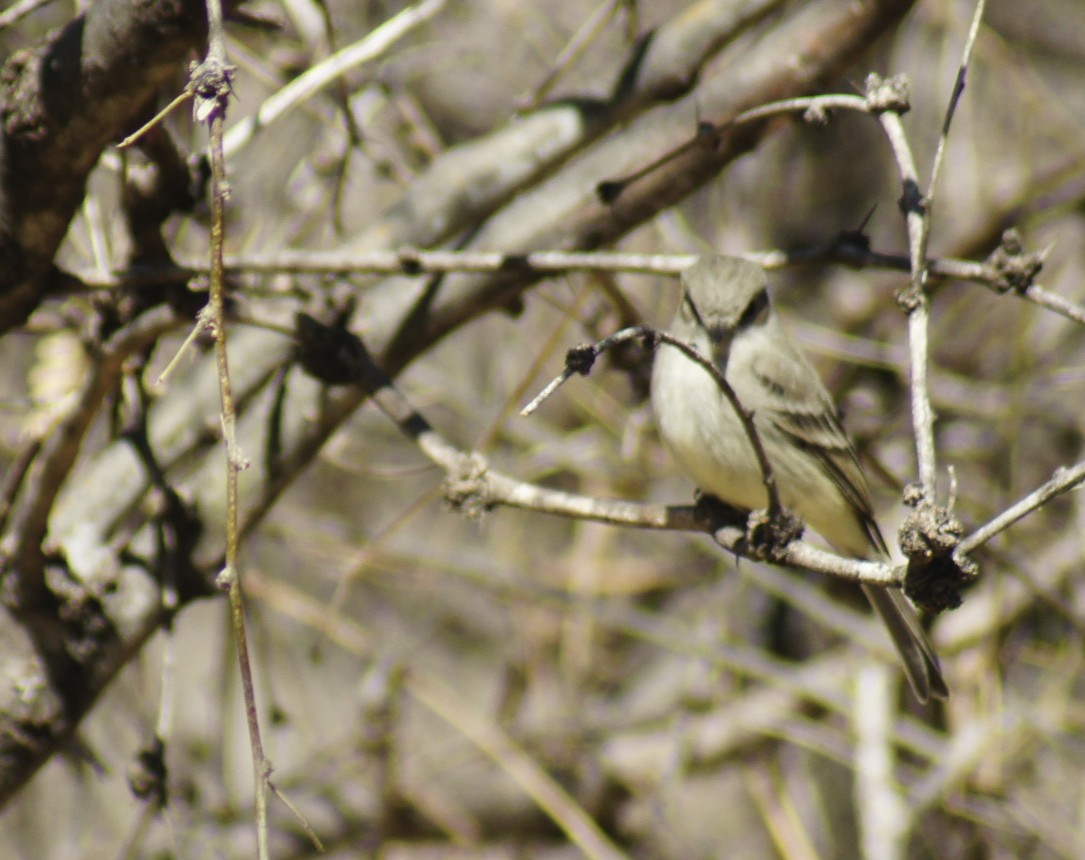
I first saw this bird in February around Patagonia Lake in southeast AZ and thought it was a Gray Flycatcher. Gray's and Dusky Flycatcher's look very similar, except that Grays have a slightly longer tail and the adults are a bit paler. I think I'll stick to Gray for this bird, but some nagging feeling says this could turn into a Dusky at any moment...or even something much, much more embarrassing.


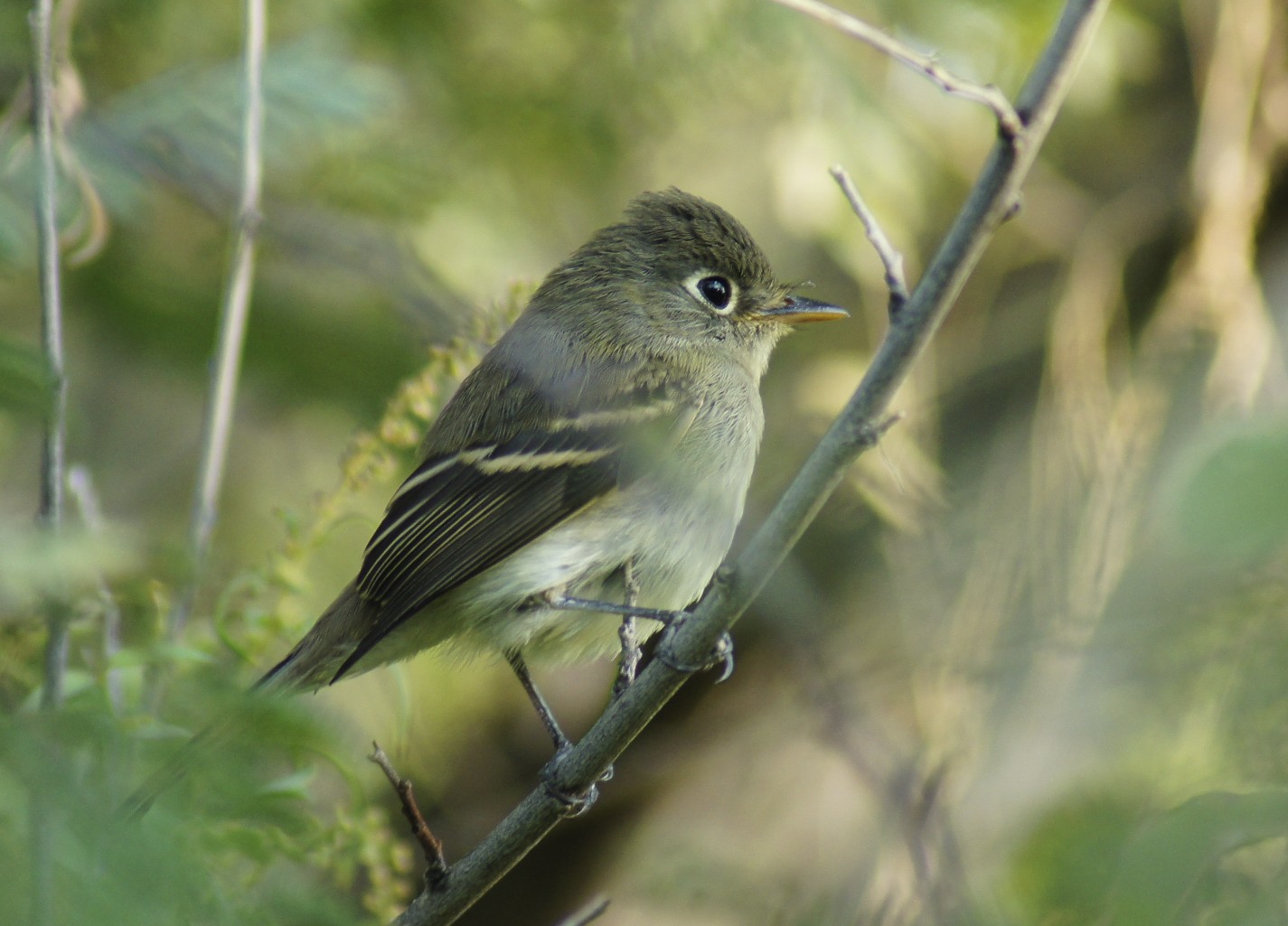
Also around Patagonia I saw this Hammond's Flycatcher. Going just by general color and demeanor, a Hammond's can turn into a Dusky or Gray Flycatcher too, but luckily they have noticeable longer primary projections on their wings.


With other empids, the wings extend to the base of the tail, but the Hammond's has a longer reach relative to its body. Also, this one posed nicely for me, which makes it my favorite empid right now.


Here in Phoenix, the Pacific-Slope vs. Cordilleran war rages at the Desert Botanical Gardens every summer. Both birds can pass through the area during migration, and they're physically indistinguishable if they keep quiet, which of course they do. How many Gulls or Sparrows or Shorebirds are there that are literally indiscernible from each other unless you hear them call (Probably lots more than I am aware of huh?)?

I have seen these Flycatchers every time I've been to the Desert Botanical Gardens in the summer. Because the Cordillerans typically stay in the higher altitudes, the general opinion among the DBG regulars is that the Flycatchers at the DBG must be Pacific-Slope. However, it's pretty far inland for Pacific Slopes too, so it still doesn't seem any more likely to me that it's one or the other based just on their normal ranges. The Sibley's field guide doesn't show either coming into the Phoenix area much, but the Cordilleran's summer range, though normally at higher altitude, is nearer by. Sibley only shows the Pacific-slopes coming through central Arizona during migration. Empids like the one below can be found at the DBG throughout the whole summer, even on the same perches, which makes me think they're not just migrating through, but are actually sticking around for a few months. Given the options, it seems to me that the likelier bird is the Cordilleran, which at least is a summer resident in nearby parts of the state--even if I must contravene The #1 World Birder's 4th rule about trying to be a better birder.


After so much empid stress, it's nice to find repose with a few easier specimens. So the Olive-sided Flycatcher isn't actually an empid; it's a Pewee. I just included it here because I think they're very cool and really appreciate that they're straightforward to ID. These guys drip class, and you know they like to drink dry martinis, with a couple olives...


The bird photographed below is probably a Willow Flycatcher. I'm ashamed to admit it, but I have a hard time discerning these guys from Western Wood Pewees. The Wood Pewees like to perch up higher, whereas these Willows like the little scrub stuff near marshy water, case in point:


I'm wanted to call this guy an Acadian Flycatcher because it seemed too light all round to be Willow. When I photographed this bird in southeast Pennsylvania, it was within Acadian range. However, the Acadians are supposed to be high tree dwellers like the Pewees, and this fellow was working the low shrubs. Upon further review, I thought this might be an Alder Flycatcher, but honestly its face seems too light to match any of those birds really well. It seems to lack the darker lores of both the Alder and Willow Flycatchers, which brings me back to the lighter-faced Acadian... Suggestions?


Anyway, here's a definite Willow Flycatcher. However, it's not obvious from the photo, since the beak looks too orange and the head looks too crested/peaked--in fact he looks a lot like the ambiguous bird above. But unlike all the other empids I've seen this year, this guy let out a mighty "RITZbew" while I was observing. 


Many birders have gone half mad and half insane trying to sort these guys out. It's more crazy-making than trying to contemplate the cardinality of infinite sets that can be greater or smaller than each other despite all being infinite! When the empid finally calls, it is a sweet mercy. Now if only I could recognize their calls...

Monday, August 27, 2012

Mon-late Monsoons

We've had some fun weather these past couple of weeks in Phoenix, with the August heat punctuated by intermittent monsoon aftershocks. It's like living in Dallas again-- 100°F at 7 am and then thunderclouds by noon. Silly troposphere just can't make up it's mind. Funky weather makes for funky birding as the daylight alternates by the hour and throws off feeding times.

Whatever mayhem the funky weathers visits on the birds is magnified for reptiles like this Twin-spotted Spiny Lizard, perhaps the only critters in Phoenix this time of year who really appreciate full sunlight.


The European Starlings at the DBG like to tune their voices in the overcast evening light. Their beautiful plumage almost makes up for everything that these birds have going against their popularity. Without any larger context, this bird is an emerald and ebony gem. The luster starts to fade when one considers how common they are, that they're introduced, and that they displace other species. Oddly enough, European Starling populations are actually decreasing in Europe--isn't that a weird thought.


The funky weather really got to this Inca Dove. It just kinda froze in the middle of a gravel path and stood perfectly still, perhaps waiting for the sun to reemerge. From its gaunt physique, I'd say this is likely a first year bird, and one who does not yet have the necessary life experience to know what to do when the sun is gone by 4pm.


Other birds at the DBG have problem adjusting at all. This Great Horned Owl was plunked on up in a mesquite tree. From his concealed position, he kept tabs on all the little bunnies hopping around below him and contemplated violent things.


Just to make sure this was, in fact, a Great Horned Owl, and not some other bird in disguise, I checked off some tell-tale characteristics.

Large Eyes and ability to turn head 180°-- check 


Large, intimidating, zygodactyl talons -- check


Gruff personality and sense that this awkward biped is an affront to an owl's regal existence? -- check


While the tiger owl waited up high, this debonair Cactus Wren, strutted around down low. The largest and loudest of the North American Wrens, these towering troglodytes act like they own the place. Seeing as they are the state bird, they may have a case. I like the pose here, and feel like this Wren should have a flag waving behind him in the background.


I'm sure that by the time this post is up, the clouds will be gone. As we're still in monsoon season, they'll probably be back this evening. Here's hoping.

Thursday, August 23, 2012

Bird Word: Code Rufous

Everyone loves jargon. At least, if you're a part of the group that understands it. Every group and every hobby, every lifestyle and every profession comes with its own jargon, and those who love birds are not without their special bird nerd words too. A lot of the esoteric bird verbiage has to do with abbreviations and acronyms in bird names, or identifying certain parts of a bird's anatomy. There's something both cool and risible about the specialized language employed by birders and ornithologists. For my money, people that can pull it off seem all the smarter.

Rufous-capped Warbler

Today I was struck by a simple, plebeian bird word, one is is almost use too often and with too much understanding that we may not realize its real eccentricity. 

"Rufous," from the Latin rufus (reddish), is a readily recognized bird description. There are more than 174 species of bird with "rufous" in their name, roughly  1.7% of all birds worldwide. This means that in any random assortment of 100 birds, you'll find 2 that are Rufous-something-or-other. 

Rufous-backed Robin

And then there are all of the birds that have rufous coloration on them, but not in their name. For me, it is a great relief to be able to describe anything in the red-range as "rufous" and then feel like I'm covered. 

Rufous Morph Cassin's Sparrow

It seems to be such a versatile word, or at least a very well-applied word, in the bird nerd world. There's a bit of carry-over into mammalian and invertebrate descriptions, but all in all it doesn't come up outside of biological settings. 

Rufous-crowned Sparrow

"Rufous" was first used/recorded in 1782 (according to wikipedia), so it's a relatively new term for one based in a language over 2,000 years old. How often do you hear "rufous" come up anywhere else? Even in a 48-count box of crayolas, you'll get "scab-red" and "brick-red," "burnt orange" and "burnt sienna,"red-orange" and "outrageous orange," but no rufous. If it's not codified in crayola, is it real? Well, at least in the bird nerd world it's real. I've been able to photograph 5 different rufous named bird (4 actually, since Rufous-sided Towhee no longer exists). 

Spotted Towhee, once a part of the Rufous-sided Towhee conglomerate

What are some other instances of Rufous you have found, bird-world or otherwise? What's missing from this Rufous anthology? Share a comment; share a link.