Thursday, June 21, 2012

Out of the Woods and Back in Town

Well, you all have been great sports while I've done post after post about birding up in Pennsylvania. Here we are finally. We're out of the woods, so to speak, with these last two birds from my wonderful Pennsylvania vacation. In a certain sense I saved the best birds for last, not photographically speaking, but in terms of the experience I had in finding them.

This Ovenbird was the only new Warbler I saw in Pennsylvania. I find myself rather pleased and surprised to say that I'm not disappointed in how few wood Warblers I found. I wasn't overly optimistic to begin with, and in fact wasn't even really expecting an Ovenbird. I found this quirky character hopping around in the undergrowth at Ridley Creek State Park during an afternoon thunderstorm. The temporary downpour had driven all of the other birds into hiding, but this lowlife (in the sense that he lives low to the ground) had plenty of cover and seemed unperturbed. Watching him hope around in cadence with the pitter-patter of the rain was a very cool experience, one I seldom have back in Arizona.


Ovenbirds are named for the shape of their nests, and perhaps also for their prowess in the confectionary arts. I didn't see any nests around, and in fact this bird didn't stick around for very long either. That's the way with Warblers, and even though the Ovenbird looks more like a compact Thrush than a Warbler, it's a handsome bird in any setting.

The White-eyed Vireo was the last bird I added to my Pennsylvania/New Jersey list, new bird number twenty-two for the trip. I had been wanting to see one of these Vireos for a long time. They are much more frequently heard than seen, and it was on my last day of birding that one began chiming out from some marginal woods at Stroud Preserve. I was birding with some folks from the West Chester Birding Club,  for whom this must have been a common occurrence, as they quickly ambled on after a possible Lincoln's Sparrow (a common bird out west, but a rare sighting in Pennsylvania). Well, my priorities were much different, so I plunked down and waited to see if the Vireo would come into view. The Lincoln's Sparrow never materialized, but after about ten minutes the White-Eyed Vireo popped up and gave me a great look at those namesake peepers.


Looking in books and online, I never really appreciated all the different yellows on this bird until I saw it in person. Of course, the white eye, situated in the bird's unusually bulbous head, is the most striking feature, but all together the White-eyed Vireo is a beautiful little thing. Since it was shady and overcast, the autofocus on my camera was having trouble. I had to shoot with manual focus, and mercifully a couple shots came out half-decent--never something for me to take for granted with a new bird.

Back in Phoenix, I visited the Gilbert Water Ranch in the evening, and was shocked at the low levels of bird activity. I've been there in the summer before and still never recorded less than thirty species. The place was about as dead as it can be, and there was even some water in the basins. Needless to say it made me miss the Pennsylvania woods.

There were lots of juveniles around, so the local bird populations seem to be doing pretty well. Even so, that sweltering heat really, ironically, puts a damper on things. This little duckling couldn't stand to have his fuzzy face out of the water.


Though his black and white coat was coming in nicely, this young Gila Woodpecker was also pretty frazzled. Unlike the cactus of which they are so fond, these birds can't go for months without water.


The juvenile Abert's Towhees definitely seemed to be coping the best, and this was to be expected. Towhees seem to be one of the few species here in Arizona that can be found outside feeding and bouncing around regardless of the time. Morning is just as good as noon for these scrappy birds, but that may be in large part because they're never far away from the shade.


I also checked the Glendale Recharge Ponds which, like the Water Ranch, were surprisingly full of water and vegetation. Unlike the Water Ranch, Glendale was also full of waterfowl. Hundreds of Black-necked Stilts fill the basins, accompanied by almost as many Avocets and Killdeer. Several American Wigeons and a pair of Northern Pintails provided some puzzlement, and a low flying Peregrine Falcon gave everyone a buzz.


With some selective cropping, one can make these basins appear as though they're part of some wonderful waterworks, instead of an improvised oasis in the middle of desert suburbia.


Despite all my complaining, in a way I am actually looking forward to the temperature increase in Phoenix. Most of the good birding must be done at higher elevations now anyway, so taking it as a given that I won't see a lot in the valley, it'll fun to say I've been birding in 120° F heat, maybe even start a separate list for that extreme!

Tuesday, June 19, 2012

Gull-ible at Barnegat Bay

As a part of my Pennsylvania trip earlier this June, I made a rare visit to the east coast. The prospect of doing some birding along  the New Jersey shore was very exciting, even if we weren't heading to Cape May or some of those other famous sites. We set our sights on lovely Barnegat Bay, a strip of beach with beautiful scenery and, as it turned out, a few birding treasures of its own. Since I had only been to the Atlantic coast a few times, the prospects of seeing some new and cool birds were great. The Jersey shore did not disappoint, and in fact it exceeded my expectations. Even before I arrived at the beach, we started to see new birds, with sentinels such as this handsome Laughing Gull dotting utility poles along the road.


We saw Gulls high atop the famous old Barnegat Lighthouse and soaring along the coastal thermals. We also saw them along the lowest points of the Barnegat wharf and shoreline, sometimes in very compromising positions. Gulls can live high and they can live low. You don't become one of the most successful avian groups without making a few compromises.


The Seagull is often used as a symbol for freedom and versatility in literature. Most appropriately for birders, it can represent the unattainable ideal, something you want but can never possess. Keeping in mind the different plumages and vast ranges many Gulls have, as well as the propensity for many Gulls to turn up in unexpected places, I think Gulls embody the frustration and excitement of an unattainable ideal very well.  Especially for a non-coastal person like me, almost every Gull is a potential new bird, but they're so often ambiguous and identifying them is seldom a certain thing. Here, to make the point, are some mid-cycle Ring-billed Gulls. Or at least I think. Maybe Herring Gulls? Maybe not. They could also be space aliens.


Maria and I counted four different species of Gull along the Barnegat shore. The Laughing Gulls were by far the most visually striking and the most graceful of the bunch. Seagulls are pretty talented aviators, but the way that the Laughing Gulls rose and cut and dove almost put them in the Tern and Kite class of flyers. They had serious skills.


The Laughing Gulls were most comfortable in the air, and unlike the other Gulls, I never saw them on the ground. Conversely this third/fourth year Herring Gull seemed to abhor the very idea of flight. Even as I approached it, the bird started to walk out into the ocean instead of taking to its wings. I've seen some impressive flight displays from Herring Gulls and Ring-bills before, so this one must've just been pretty tuckered, or else it was just really wanted to soak its feet.


The Herring Gulls were the most numerous on our stretch of the Jersey beach, and they were visible in the air on the ground, floating atop the water, and popping into trash cans along the peer. Bulky, large, noisy, common, versatile, and semi-indestructible...surely this is the quintessential 'Seagull'.


It is often said that cockroaches and rodents would be the sole survivors of a nuclear holocaust. I'm putting my money on the Herring Gull. This is the cold calculating stare of a bird that can be caught at the epicenter of an atomic explosion and fly away wondering what's for dinner.


The most impressive Gull on the beach was, by far, the Great Black-backed. Their range in North America may be only a tiny fraction of the Herring or Ring-billed Gulls' range, but with a wingspan well over five feet, this bird more than compensates.


The Great Black-backed is the largest Gull in the world. The few that we saw at Barnegat Bay cruised low and slow along the beach, confident in their size and the proper awe they inspired in all whom they passed.


Folding in those wings must be a bit of a chore (I can sympathize too). This Gull held its pose for a little while, so maybe they were just telling me that they were tired of being spied on, and were pointing me in the direction of other cool stuff to see. 

"Go bother those Oystercatchers over there"

As I moved beyond the shoreline and out onto the rocky wharf around the bay, I realized that the awesome birding was just beginning. I already related the story of the Purple Sandpipers, and there are still many cool birds to come! 

Monday, June 18, 2012

Quiz Closure

Thanks to Chris, Jen, Mia, and Dan for submitting answers--You all are champs!

Here are the answers for the birding pop quiz:

1) Willow Flycatcher. The coloration on the beak is a bit misleading here (due to lighting), but the call (supplied in the hint) is diagnostic. Mia and Jen, nice work!


2) There's not too much to go on with this photo. The olive green back and white belly help narrow it down, but the slight, blurry hint of red on the eye, along with the broken eye-ring, point to Red-Eyed Vireo--Nice work Jen!


3) I cringe at this sign every time I visit the Gilbert Water Ranch...oh the shame it brings upon Arizona birding. As you all mentioned, it's an Abert's Towhee, and the White-throated Sparrow was pictured in place of the proper White-crowned Sparrow. Every state has a few skeletons in the closet I guess...


4) There are only two wood Thrushes (so, excluding Robins and Bluebirds) one can expect to see in north central Arizona in the summer. This bird is unusual in that is seems to lack the eye ring found both on Swainson's and Hermit Thrushes. The lack of any rusty coloration on the tail, and the overall gray coloration, point towards Swainson's, but to be honest I'm not 100% on this bird.


Thanks to all for playing!

Sunday, June 17, 2012

Quiz Time!

Last time I tried one of these nobody responded...but here for the brave or bored (or both) are a few ambiguous birds to try and identify. Feel free to post any responses in the comments below : )

1) Taken at Stroud Preserve, southeast Pennsylvania, in June:


Hint: fitz bew!

2) Taken at Ridley Creek State Park, southeast Pennsylvania, in June: 

 Hint: Seeing Red

 3) Taken at the Riparian Preserve in Gilbert, Arizona. Can you spot the two mistakes on this sign?


4) Taken at Kehl Springs, north central Arizona, in June.

 Hint: "Don't rush if it's a Thrush"

Friday, June 15, 2012

Thinking of Bobolinking

There were lots of yellow birds and blue birds, brown birds and clown birds in Pennsylvania. It was a great trip and, all tallies in, I saw twenty-two new bird species. It is difficult to pick one bird-related highpoint from my trip to the northeast, but few birds provided as satisfying a sighting as the mythical Bobolinks.


An enigmatic, backwards-seeming creature, the Bobolink was only confirmed to exist a few years ago. Until recently, most people reporting these birds were dismissed as madmen, hoaxsters, or visually impaired. Even when photographs and recordings of these birds started to surface, they were dismissed as grainy shots of leucistic, balding Red-winged Blackbirds:


But birders are a determined people. Despite forcible government suppression and a media black-out (notice how there hasn't been a single mainstream news story about this species!) they kept hope alive. When a Bobolink finally crashed into one of the White House windows, the bird's existence could be publicly denied no more.

But why? Why was there such resistance to confirming this species? As it turns out, Bobolinks aren't all that uncommon or hard to find. They can be found happily bobolinking in fields and flatlands throughout much of the eastern United States at points throughout the spring and summer.

 Rural Pennsylvania is not exactly off-the-map

Perhaps it's because the Bobolink is such a dumbfounding creature. There is something inexplicably backwards about the male Bobolinks. Their whole front is black. Is there any other bird like that, that isn't also entirely black? And what's with these weird haircuts, all the blond in the back? These may seem like trivial reasons to deny the legitimate existence of a species, but hey the only reason scientists won't recognize Bigfoot is because he doesn't wear shoes.

I've read that the reversed counter-shading on Bobolinks (normal counter-shading means birds tend to be dark on their backs and paler on their fronts) helps the males stand out in their grassy habitats, in essence helping the females find them. 

It's possible that my whole anecdote is erroneous, but whatever the true case may be with the Bobolink, they're established now (though they are, unfortunately, declining in some areas). I found about a dozen of these interesting birds at a Bobolink meet n' greet hosted at Stroud Preserve in West Chester, PA. It seemed like the first time our socializing for some of the males, and they were too busy with their nervous eating to work up the guts and actually talk to any of the shy females. 

A real charmer, isn't he?

Then again, some of the females seemed preoccupied with the vittles too. It is ostensibly possible that the large gawking biped made them uncomfortable, but I was wearing a tuxedo and I had shaved the back of my head, so I should've blended right in...


Like so many proms and socials, this one may have been a let down for the Bobolinks. I'm sure they've since hit it off, and I can say I certainly left the first get-together very happy.


Bobolinks are great migrators, moving between Brazil and the the American northeast every year. This year I migrated to meet them too. These curious critters provided one of the birding highlights of the 2012 year!

Tuesday, June 12, 2012

Pennsylvania Penny Birds

There are many great aspects of birding in a new area--tons of new species to see, new areas to explore, the excitement of discovery all renewed. As I discovered in my recent trip to Pennsylvania (and if you all are tired of hearing about this trip, apologies, cause there's still much more mwuahahaha!), another great effect of birding away from home is that, wherever you're staying, you get different yard birds. By this I mean those normal, common species you see up close and around the house, around the park, in the alley, etc.


And perhaps none are so common as the Grey Catbird

In Arizona one can expect Mourning Doves, Inca Doves, White-Winged Doves (in hot months) Gamble's Quail, Curve-Billed Thrashers, Mockingbirds, Abert's Towhees--in essence the less vibrant desert birds. It was nice to briefly exchange these common visitors for the Robins and Catbirds in the northeast, for the Wrens and Cardinals and Chickadees. They didn't bring the same excitement as new life-list birds, but they really helped to set the atmosphere, an atmosphere very different from the Phoenix bird scene. And isn't that in large part what a vacation is all about?


House Wrens are fairly common and pretty noisy, but you won't find many of them around central Phoenix. This House Wren had a very tidy little straw hovel at Ridley Creek Park. It would pop out every few minutes to get a sense of the neighborhood goings on, and then disappear again into its house.


This was the closest I've been to a House Wren, and of course Of Course there's one little twig obscuring the bird's eye. Ugh...


When it comes to little brown birds around the yards and parks, the Chipping Sparrows give even the Eurasian House Sparrow a run for their money. They're a bit more shy, but also more vocal and, if I may so proclaim, more beautiful.


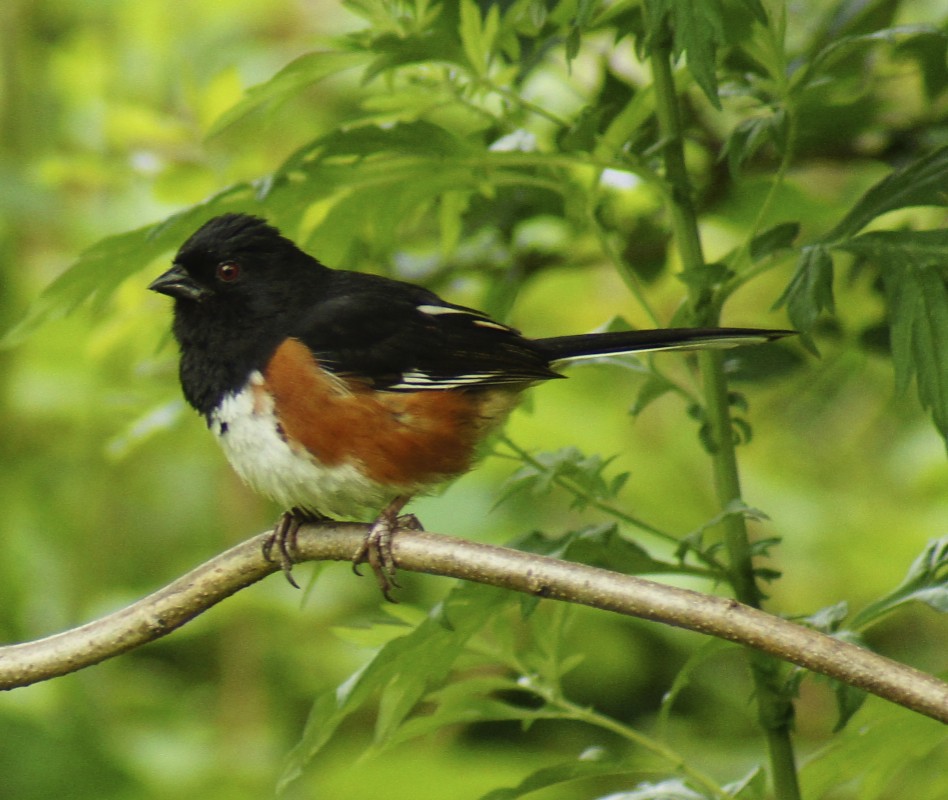
The Unspotted Towhee err.. Eastern Towhee, is another important denizen of the old wood undergrowth. They don't have the spots like our nifty (western) Towhee, but they're still very pretty and they work hard as they shuffle around the leaf litter.

Rest assured Eastern Towhee, someday you'll earn your stripes...I mean spots.

Sunday, June 10, 2012

Feeling Blue

I found a healthy helping of yellow birds in Pennsylvania, but yellow was not the only color putting on a strong display (why does it feel like I'm describing a Sesame Street episode?). The blue birds of Pennsylvania were also out in force. 

I had many opportunities to observe the lovely Eastern Bluebirds in the cloudy weather. It is fortunate that the overcast haze obscures the coloration a bit. Their electric blue is known to cause temporary blindness and paralysis if viewed in an un-filtered fashion. So, really, I'm doing you a favor dear reader...


The Eastern Bluebirds are told from their Western counterparts by the cleaner white on their bellies and the rusty colored chin (Western Bluebirds, shown below, have blue on their chins). This chin discrepancy has led to great debate among the Bluebirds.


The Western Bluebirds claim that, because they have blue chins, they're the truer and bluer of the bluebirds. The Eastern Bluebirds claim that they're just more comfortable and secure in their overcoat of blue, and so don't need to be showy or tawdry in their facial coloration. Of course, the sad truth is that the Mountain Bluebird puts both species to shame in terms of straight blue-ness, but neither Eastern nor Western Bluebirds like to talk about that.

It's an unsettling debate; one that's caused many the Bluebird to lose its balance.


And then there's the Indigo Bunting, which is such a rich blue that it's been formally disqualified from comparisons to the Bluebirds by the American Birding Association. I saw my first Indigo Buntings just a few weeks ago in Phoenix, and have now seen several more in Pennsylvania, where they were a little more accommodating.


With this much blue on display in PA, it is recommended that one does not listen to the blues or eat blueberries while out birding. It might cause a catastrophic sense-overload.

Saturday, June 9, 2012

Yellow Birds of Pennsylvania

I went to Pennsylvania this summer with high hopes and expectations for some great birding. There were lots of new birds to see, and lots of old birds to see better. The Yellow Warbler and Common Yellowthroat certainly fall into the second category. They're both pretty common in Arizona, but I have found that it is much more difficult to get clear, unobscured looks at these birds in their Arizona habitats.

They're even more common in Pennsylvania, and here in the West Chester area they are much more brazen, much more conspicuous. Of course, they're Warblers, and Warblers seldom take it easy on photographers. But the opportunities are better and more numerous here. Finally I came away with a decent shot of a Yellow Warbler.


The difference between Arizona and Pennsylvania Yellowthroats is especially noticeable. The Common Yellowthroats in Arizona live in the thick reeds along water features and seldom come out in the open. Although not in huge numbers, they do breed and nest in the state. I have never seen them really displaying, singing, or socializing. It's all shadows and secrecy in AZ.


In Pennsylvania, I checked out Stroud Preserve, Ridley Creek State Park, and Exton Park, three great preserves in the West Chester area. At every single one of these sites, I've been privileged to see Yellowthroats perched and singing up in the trees, foraging out in the open and moving with much more publicity than in Arizona. My photos are still a bit hampered by the continually overcast weather, but I do appreciate the lower temperatures.


I really like Common Yellowthroats. They look like Tweety Bird from those old Loony Tunes combined with Zorro.


The Warblers aren't the only yellow birds I've been enjoying lately. This spring has already afforded me great looks at Bullock's and Hooded Orioles in Arizona, and now I've had a chance to see the eastern varieties too.

The male Baltimore Oriole is a beautiful thing. Given the haziness in this shot, you may just have to take my word for it. Hopefully, you've seen a few of your own!


The Orchard Oriole is the comparably drab cousin of the Baltimore Oriole. Their orange is a more unique, rusty coloration, but this sets them apart and, for my money, makes them one of the most interesting and beautiful Orioles in the group. Unfortunately I have not seen any mature males. A first-year, along with this lovely female, have sufficed.


Like Marsh Wrens, Yellowthroats, Song Sparrows, and other birds that prefer tall grasses and reeds, the Orchard Oriole is pretty flexible.


*Update: The morning I scheduled this to post, I saw a male Orchard Oriole too. Although this male, like the Baltimore, makes this post less yellow, it seems appropriate to include him here too:


Birding in southeast Pennsylvania is mellow, and there is plenty of yellow. Both of these characteristics suit me just fine!