Tuesday, June 12, 2012

Pennsylvania Penny Birds

There are many great aspects of birding in a new area--tons of new species to see, new areas to explore, the excitement of discovery all renewed. As I discovered in my recent trip to Pennsylvania (and if you all are tired of hearing about this trip, apologies, cause there's still much more mwuahahaha!), another great effect of birding away from home is that, wherever you're staying, you get different yard birds. By this I mean those normal, common species you see up close and around the house, around the park, in the alley, etc.


And perhaps none are so common as the Grey Catbird

In Arizona one can expect Mourning Doves, Inca Doves, White-Winged Doves (in hot months) Gamble's Quail, Curve-Billed Thrashers, Mockingbirds, Abert's Towhees--in essence the less vibrant desert birds. It was nice to briefly exchange these common visitors for the Robins and Catbirds in the northeast, for the Wrens and Cardinals and Chickadees. They didn't bring the same excitement as new life-list birds, but they really helped to set the atmosphere, an atmosphere very different from the Phoenix bird scene. And isn't that in large part what a vacation is all about?


House Wrens are fairly common and pretty noisy, but you won't find many of them around central Phoenix. This House Wren had a very tidy little straw hovel at Ridley Creek Park. It would pop out every few minutes to get a sense of the neighborhood goings on, and then disappear again into its house.


This was the closest I've been to a House Wren, and of course Of Course there's one little twig obscuring the bird's eye. Ugh...


When it comes to little brown birds around the yards and parks, the Chipping Sparrows give even the Eurasian House Sparrow a run for their money. They're a bit more shy, but also more vocal and, if I may so proclaim, more beautiful.


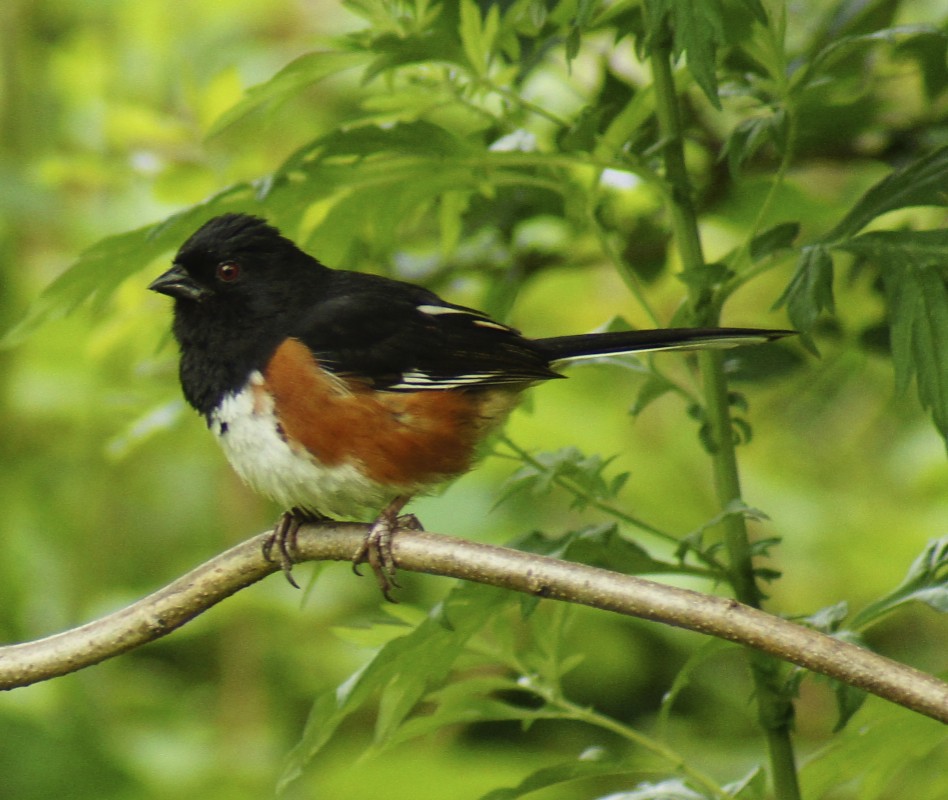
The Unspotted Towhee err.. Eastern Towhee, is another important denizen of the old wood undergrowth. They don't have the spots like our nifty (western) Towhee, but they're still very pretty and they work hard as they shuffle around the leaf litter.

Rest assured Eastern Towhee, someday you'll earn your stripes...I mean spots.

Sunday, June 10, 2012

Feeling Blue

I found a healthy helping of yellow birds in Pennsylvania, but yellow was not the only color putting on a strong display (why does it feel like I'm describing a Sesame Street episode?). The blue birds of Pennsylvania were also out in force. 

I had many opportunities to observe the lovely Eastern Bluebirds in the cloudy weather. It is fortunate that the overcast haze obscures the coloration a bit. Their electric blue is known to cause temporary blindness and paralysis if viewed in an un-filtered fashion. So, really, I'm doing you a favor dear reader...


The Eastern Bluebirds are told from their Western counterparts by the cleaner white on their bellies and the rusty colored chin (Western Bluebirds, shown below, have blue on their chins). This chin discrepancy has led to great debate among the Bluebirds.


The Western Bluebirds claim that, because they have blue chins, they're the truer and bluer of the bluebirds. The Eastern Bluebirds claim that they're just more comfortable and secure in their overcoat of blue, and so don't need to be showy or tawdry in their facial coloration. Of course, the sad truth is that the Mountain Bluebird puts both species to shame in terms of straight blue-ness, but neither Eastern nor Western Bluebirds like to talk about that.

It's an unsettling debate; one that's caused many the Bluebird to lose its balance.


And then there's the Indigo Bunting, which is such a rich blue that it's been formally disqualified from comparisons to the Bluebirds by the American Birding Association. I saw my first Indigo Buntings just a few weeks ago in Phoenix, and have now seen several more in Pennsylvania, where they were a little more accommodating.


With this much blue on display in PA, it is recommended that one does not listen to the blues or eat blueberries while out birding. It might cause a catastrophic sense-overload.

Saturday, June 9, 2012

Yellow Birds of Pennsylvania

I went to Pennsylvania this summer with high hopes and expectations for some great birding. There were lots of new birds to see, and lots of old birds to see better. The Yellow Warbler and Common Yellowthroat certainly fall into the second category. They're both pretty common in Arizona, but I have found that it is much more difficult to get clear, unobscured looks at these birds in their Arizona habitats.

They're even more common in Pennsylvania, and here in the West Chester area they are much more brazen, much more conspicuous. Of course, they're Warblers, and Warblers seldom take it easy on photographers. But the opportunities are better and more numerous here. Finally I came away with a decent shot of a Yellow Warbler.


The difference between Arizona and Pennsylvania Yellowthroats is especially noticeable. The Common Yellowthroats in Arizona live in the thick reeds along water features and seldom come out in the open. Although not in huge numbers, they do breed and nest in the state. I have never seen them really displaying, singing, or socializing. It's all shadows and secrecy in AZ.


In Pennsylvania, I checked out Stroud Preserve, Ridley Creek State Park, and Exton Park, three great preserves in the West Chester area. At every single one of these sites, I've been privileged to see Yellowthroats perched and singing up in the trees, foraging out in the open and moving with much more publicity than in Arizona. My photos are still a bit hampered by the continually overcast weather, but I do appreciate the lower temperatures.


I really like Common Yellowthroats. They look like Tweety Bird from those old Loony Tunes combined with Zorro.


The Warblers aren't the only yellow birds I've been enjoying lately. This spring has already afforded me great looks at Bullock's and Hooded Orioles in Arizona, and now I've had a chance to see the eastern varieties too.

The male Baltimore Oriole is a beautiful thing. Given the haziness in this shot, you may just have to take my word for it. Hopefully, you've seen a few of your own!


The Orchard Oriole is the comparably drab cousin of the Baltimore Oriole. Their orange is a more unique, rusty coloration, but this sets them apart and, for my money, makes them one of the most interesting and beautiful Orioles in the group. Unfortunately I have not seen any mature males. A first-year, along with this lovely female, have sufficed.


Like Marsh Wrens, Yellowthroats, Song Sparrows, and other birds that prefer tall grasses and reeds, the Orchard Oriole is pretty flexible.


*Update: The morning I scheduled this to post, I saw a male Orchard Oriole too. Although this male, like the Baltimore, makes this post less yellow, it seems appropriate to include him here too:


Birding in southeast Pennsylvania is mellow, and there is plenty of yellow. Both of these characteristics suit me just fine!

Thursday, June 7, 2012

Purple Haze

I went to Barnegat Bay and hung out near the famous old lighthouse on the northeast tip of Long Island Beach. The sea breeze and sound of breaking waves--these are things no person should go without for too long, and it was very nice to walk along sandy shores again.

The birding in the area was also exceptional, at least for an Arizonan like myself. I photographed a lot of new species, but perhaps none more interesting than this Purple Sandpiper.


I thought I recognized the bird, but having very little experience with shorebird IDs, I didn't think much on the matter while at the beach. It was only while entering my sightings into eBird that the little flag shot up. These birds winter along the Atlantic coast, but it is pretty unusual to see one still lingering in June.


Thus, I am only left to conclude that this Purple Sandpiper waited around expressly for me to come and see him, which was very cordial of the stout little shorebird. It's a beautiful species, and it was a pleasure to watch him scuttle and forage along the rocky wharf with a dexterity I could not manage even in my dreams.

On this third photo, I can actually see and appreciate the subtle purple coloration on the feathers, which I'll admit escaped me while observing the bird in person.


I believe this second bird is a juvenile Purple Sandpiper. I'll admit, I was hoping it was another new species, but it matches petty closely with other photos I cross-referenced online.


I originally thought this bird below was a precocious youngster. I received some insightful feedback (here's to you, Seagull Steve) though that leads me to believe it is, in fact, a Purple Sandpiper in its breeding plumage. Left to my own devices, I am embarrassed to say I would've assumed the Purple Sandpiper to get more purply when its breeding time. All the same, this makes me feel even more lucky.


The Purple Sandpiper is referred to as a bird of extremes. It likes to feed near breaking waves, and it winters farther north than any other shorebird. I guess this pair wanted to prove that they were indeed extreme, but by no means predictable. Now they're going to stick it out through June longer than any other arctic breeder, so ha!

Wednesday, June 6, 2012

King of the East

In the western half of the United States we are blessed with many different avian monarchs. In Texas, for example, an enterprising birder can hope to see Cassin's, Western, Tropical, and even Couch's Kingbirds all within the same month, even at the same location.

In the eastern United States, there is only one king. He is mean, but he is stylish. He looks after his dominion with tender care, but he is merciless in the enforcement of his laws and the protections of his territory. The Eastern Kingbird rules with an iron fist (wing?). Although the bird itself can be found all the way over in the Pacific Northwest, it does not tolerate the incursion of any other Kingbirds east of the Mississippi.


The Eastern Kingbird is a bird of the people. Despite its regal posture and attitude, it does not perch on gaudy golden thrones or ornate ostentatious palanquins. It knows it is conspicuous enough perched atop nest boxes and fences posts, on utility wires and sturdy stalks of grass.


In flight, The Eastern Kingbird likes to hover and harry its prey, displaying the stability and agility of the world's finest helicopters. Many is the unfortunate insect whose dying thought has been, "What a lovely white tail band!"


Even though the Eastern Kingbird lack some of the color of its western kingly cousins, it's plumage is unique, and quite different from the western royalty. It's hard to pick a favorite between the similar Kingbirds of the west. For now, I'll choose the Eastern.

Tuesday, June 5, 2012

To Tree Or Not To Tree?

That is the question for many of the Tree Swallows in Pennsylvania. These birds are an unusual sighting in Phoenix, but they are one of the most common in southeast Pennsylvania. All along the roadsides, along fields and neighborhoods and any other expanse of open space, there are nest boxes set up to provide the Swallows and Eastern Bluebirds with quality homes. The Swallows and Bluebirds do wonders to control the insect populations, so it's advantageous for the residents in Pennsylvania to keep their populations stable. Tree Swallows are also totally stunning birds, and I was afforded many close-up looks and photo ops that I'd never had in Arizona.


The Tree Swallows have to make a tough decision. Nest in the boxes, which have a structural integrity that can only be wrought be beings with opposable thumbs, or keep to their namesake, their traditions, and nest in the Trees? Many of the Swallows preferred the nest boxes, but still liked to perch in the nearby trees and utilize their camouflage. It seems like a good compromise.


Perhaps this Tree Swallow, as evidenced by his perch atop a directional trail sign, was at a metaphysical and existential crossroads. To use the artificial nest and become a Box Swallow, or build his own and remain a Tree Swallow?


Whether they chose tree or box, all of these magnificent Swallows had the same, spectacular emerald luster on their backs. It was still too early to see the brown juveniles, who had yet to emerge from their cavity nests. The Tree Swallows were not new birds, but seeing them up close and so frequently was one of the best bird-related experiences I had in Pennsylvania.

Monday, June 4, 2012

It's That Time Again

My monthly post is up over at Birding Is Fun.

I went for a change of scenery, so if you want to get a feel for southeast Pennsylvania birding, head on over!


Saturday, June 2, 2012

The Birds Speak at Fish Creek

Last Saturday, I made the spectacular drive up to Apache Lake. Our driving itself was not especially spectacular (at least, mine wasn't), but rather the scenery, the winding desert canyons of the Superstition Mountains wowed and amazed with their colorful expanses. We took The Apache Trail/Hwy 88 up to about mile marker 224 and then parked in one of the canyons. After a brief descent, we found ourselves in the verdant, shady declivity known as Fish Creek. The creek runs for a couple miles and empties into Apache Lake. While it is not always flowing, it does serve as a nice shady respite for  lots of wildlife, and our two mile hike was filled with critters.


Upon entering the Fish Creek canyon, we were immediately greeted by Hooded Orioles and Bell's Vireos in the cottonwood trees. A few Northern Cardinals sang along the banks, and another interesting red bird, the marvelous Summer Tanager, paused to observe the curious bipeds stumbling along. This was one of two new birds we saw on this trip, and one I had been hoping to see for some time.


We saw many of the other expected desert/canyon species, including Abert's Towhees and Canyon Wrens. There were also lots of Yellow Warblers, including one male who was constantly followed and harassed by his recently-fledged chicks.While I was following this bubbly group of yellow birds through the desert scrub, I heard a harsh cry echoing through the canyon.

We looked up and saw a magnificent Zone-Tailed Hawk soaring overhead. This was a new bird for me, and it was an incredible experience to see it circling around on the canyon thermals, belting out its dominant call.


We hiked for another mile, observing Kingbirds, Gnatcatchers, and Black Phoebes all gathering nesting material. They were too busy to stop and pose for me, but the myriad of desert lizards were much more accommodating. Maybe it was just their cold-blooded nature combined with the overcast weather, but either way they were very reticent to move from their warm hang-outs. 


Eventually the water in Fish Creek ran out and so did the shady trees. We decided to turn back for the car, but not before I picked up a very nice sunburn. Much like the sunbathing lizards, I have since shed my skin and now feel like a new man!

On the way back, we were treated to more displays from the Zone-Tailed Hawk. The first bird was missing a couple of its primary feathers, and so it was easily recognizable. It was now joined by its mate, and together they glided along the canyon walls with a lofty grace and very appropriate sense of superiority.


Occasionally they would stop and perch on the dried century plants. I was never able to get very close, though I picked up lots of consolation lesions for my troubles. Nonetheless, the Zone-Tailed Hawks and their powerful calls were the highlight of the day, and provided one of the best new-bird sightings this year.

Wednesday, May 30, 2012

Uno, Dos, Tres Rios!

It's been a whirlwind of busy these last couple weeks. With school drawing to close and evaluations due, there's been little time to tend the bird blog, which is no fair at all. Being unable to post for a while, I now have a serious backlog of photos, all of which were taken at Tres Rios. I've cooed about the biodiversity at Tres Rios many times before, and as I've been reviewing these photos, it's really been driven home that, perhaps on par with the Gilbert Water Ranch, the Tres Rios wetlands are one of the best diverse birding spots in the Phoenix metropolitan area.

Tres Rios has the normal panoply of riparian birds. Green Herons, Blue Herons, Big Herons, Small Herons, Bittern Herons, Black-Crowned Herons, and even Big White Herons, which we here in Arizona call Great Egrets, can all be found along the Tres Rios marshes.


The Great Blue Herons are definitely the most numerous. They have roosting colonies set up all throughout the 3 mile Tres Rios stretch, and often stare down, condescendingly, upon the puny mortals walking below. In fact, sometimes they resemble the American Gothic painting with their stern and serious poses. 


The water works at Tres Rios are predictably flanked by cottonwood trees. These shady bastions are very welcome perches for other large birds and raptors that stay and endure the summer heat. This Red-Tailed Hawk would not endure my presence though, and took off immediately. To be fair, I've been told time and again that it's rude to stare. With birds, it's just so darn tempting...


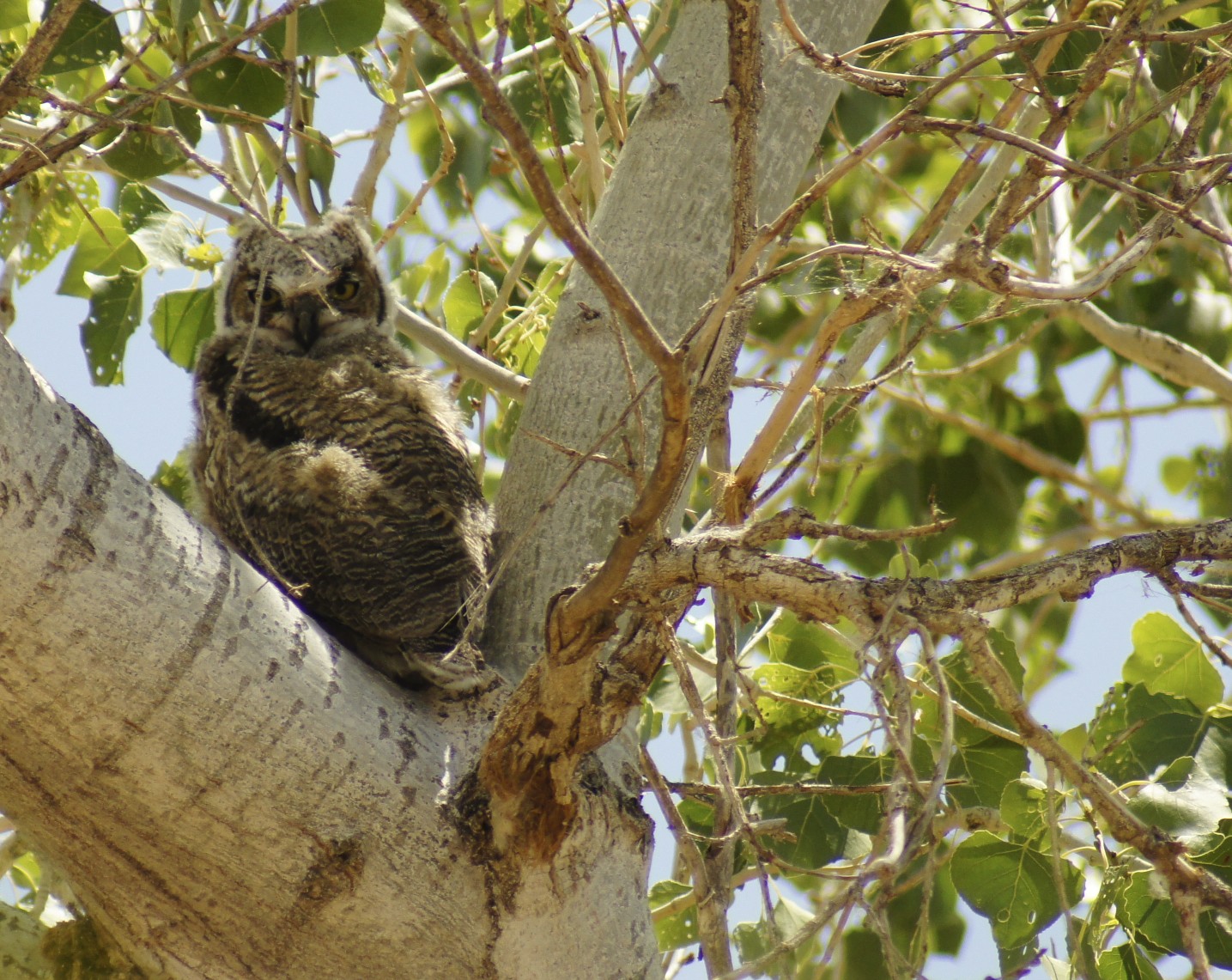
Bald Eagles, Peregrine Falcons, Harris's Hawks, Kestrels, and Cooper's Hawks can all turn up in the canopies, and there are often surprises too. About three weeks ago I came across this pair of Great Horned Owl chicks. They were each sitting in separate cottonwoods, neither of which had a nest nearby. They didn't move while I was around, so they still trusted in their camouflage better than their flying skills. 


This second chick weirded me out a little bit. Look hard at his face. His beak looks more like a koala bear nose, and some of the feathers on his face form a creepy little smile. He looked like he was contemplating all the different and delicious ways he would capture and eat me when he gets a little bit bigger.

I feel like I left a little piece of my soul lying somewhere, out there in the wilderness where I looked into this evil owl's eyes. We take great risks as birders, greater than any lion-tamer or shark-wrestler or active volcano-bungee jumper that I've ever met.


This past Friday I returned to Tres Rios with Pops and we saw three different Great Horned Owls flying around. At first I thought one was a Short-Eared Owl, since it's tufts were very small and it wasn't big enough to be a full-sized Great Horned. Soon we realized that these smaller Owls were the fledglings, now spreading their wings and beginning to terrorize the terrestrial population.


Like any successful restaurant, bar, or birding site, Tres Rios has its regulars, and plenty of them. However, its reputation extends pretty far, and lots of other summer residents and migratory birds come in for a visit during the spring. The regular birds are a foundation for great birding, but the excitement of migrants and other unusual visitors really keeps the birders coming back.

Let me know if I'm off here, but I'm pretty sure this super yellow nine inch bird is a Brown-Crested Flycatcher. (*Editor's note* Apparently I was way off here, and this is, in fact, also a Dusky-Capped Flycatcher) When I arrived at this spot, his perch was first being used by a Dusky-capped Flycatcher. As soon as the Dusky-capped flew off this Brown-Crsted flew in, as if he had been waiting his turn for some time. He must've been disappointed, because he only stayed for a minute and then also departed. His spot was immediately taken by a Mourning Dove, and at that point we moved on.


This spring I've also seen Tropical Kingbirds, Western Kingbirds, Willow Flycatchers, Cordilleran, Pacific-Slope, and Western Wood Pewees. It's been great to have so many different Flycatchers around, and not just because they keep the insect populations under control.


Other summer residents include Lucy's Warblers, along with Bullock's and Hooded Orioles. It is one of the less discussed phenomena of the birding world that Lucy's Warblers have the ability to make their features blurry, much like Sasquatch. Unlike Sasquatch, they can still be diagnostically identified by the grey body and little plum spots on their head and rump.


Then there are birds like this Indigo Bunting. This was my first confirmed sighting of these magnificent birds, and it was quite a surprise. Lazuli Buntings are a fairly common site at the preserve. Like some of the warblers, they're mostly moving up north. I have no idea what this Indigo Bunting is planning. The bird books don't show them as migrating through or residing in much of Arizona, but that's not a lot to go on these days. The Cornell website shows them as summer residents, but I haven't seen them anywhere else in central Arizona nor heard any other reports--and this bird is a real head-turner. Whatever he decides to do, it doesn't matter to me. When you look this good, you do whatever you want.


Unusual birds like the Indigo Bunting still make for an easy identification, but Pops and I have had a few mystery sightings at Tres Rios too. The swampy scrub grass draws in a lot of the little brown jobs. Song Sparrows are always in concert, and Lark, Lincoln, Vesper, and Brewer's Sparrows often join the cacophony. Soon after seeing the owl fledglings on Friday, Pops and I heard the distinct song of a Cassin's Sparrow somewhere in the ruff. We couldn't get a clear visual, but there were a few other Sparrows around--not necessarily the ones singing--that weren't easily identifiable either.

Here is the ambiguous culprit of the Cassin's song. This is a rare, rufous-morph of Cassin's Sparrow, which is already an unusual bird to find in the Phoenix area. It's a drab bird but still a pretty exciting find.


I'm pretty set on the ID of this last bird. It's a Pygmy Ostrich yes?


To visit Tres Rios is to treat oneself to a bricolage of birds, a feathered frenzy, a glamourous gallimaufry, a singing smorgasbord, a musical mélange. I highly recommend it.