Saturday, May 5, 2012

The Little Things In Life

It seems like all around the country, autumn went ahead and skipped winter, moving right into spring by the end of February. Though it's early, there are now young birds all around the Phoenix birding spots, and it's totally delightful. Of course, just because some birds have already brooded doesn't mean they're all at the same stage. This pair of Sparrows were behind the times, but better late than never!


It's great to have the spring migrations coinciding with breeding/fledging season. I was lucky to see an entire Bullock's Oriole family in the same tree--ma, pa, and 2 kiddos--a great treat and one which embodies the young and colorful feeling of this season so well.

From his colorful perch, the pater familias oversaw his brood work out the kinks in their foraging techniques. Unlike many of the other desert birds, Orioles, are pretty and proud creatures who refuse to perch on ugly things.


While pops stood proud and tall, junior skulked in the shady branches. He peered nervously around while eating, as if he was worried someone might be watching...


The Orioles like to stay higher in the trees, and this makes the color composition more interesting, if more challenging to photograph. Of course, I'd probably be grumbling if it was a new bird that I wanted to see up close--fickle as a finch am I.


Look at all these yummy flowers; this Oriole has it made! Though this bright bird's cup did overfloweth with nectar, that didn't stop him from being a real whiner. He squawked and screeched as if he thought the whole world was lucky just to hear his cracking voice. These Orioles are beautiful, but I must admit I find their sound to be bullocks.


While the Orioles are starting to fill in the tree canopies, the Gambel's Quail are pairing off down on the ground. They're much more common than the Orioles, and it's a daily occurrence to see them on their evening dates all over Phoenix. This Thursday I saw my first Quail chick of the season. The little rascal (alfalfa, I think, given its hair style) seemed to be an only child--rather odd. He'll be the oldest kid in his grade and he'll be spoiled rotten...lucky duck (Quail).


While this camouflaged couple picked through the desert detritus, Mr. Quail looked on from his elevated and verdant dinner chair. Soon his vigilance gave way to the tempting bean stalks hanging in front of him, and he started pecking away.


Foraging Quail are a common sight. This is the first time I've been able to witness the precise destructive power of the full-grown Quail beak. See the little snippets, the little bite marks taken out of the bean stalk? It is a widely believed fact that Quail bite down with an astounding 33,469,000 psi--about the same compressive force as a black hole, or Thor's vice-grips. The beans never stood a chance.


At first this stately cock kept his reserve and nibbled with the proper dignity, the dignity befitting his renaissance headgear. Eventually he lost patience and severed the stalk, rending it asunder in a way that would shock even the most iron-stomached vegetarians into carnivores.


Of all the young birds out and about these days, by far the most adorable has been this puffy, fluffy, stumpy and lumpy Curve-Billed Thrasher. I like Thrashers a lot, but I wouldn't say they're especially beautiful or aesthetically pleasing birds (except the Brown Thrasher). I wouldn't have expected them to make such cute babies. It's like the 'Ugly Duckling' story except backwards (and, I guess, we already know what species this bird will turn out to be). Most adorable chick ever? Perhaps.


There's been so much great birding these last couple weeks. It's amazing to think that things are just now heating up; there is a whole summer of birding festivals and migrants yet to come.

Friday, May 4, 2012

Roadkill Over at Birding is Fun

Hello Readers,

Today is the 4th, which means my monthly post is up over at BirdingIsFun. Between you and me, this is one of my favorites. Check it out!

Tuesday, May 1, 2012

New: The iBis 2.0 and Philandering Phalaropes

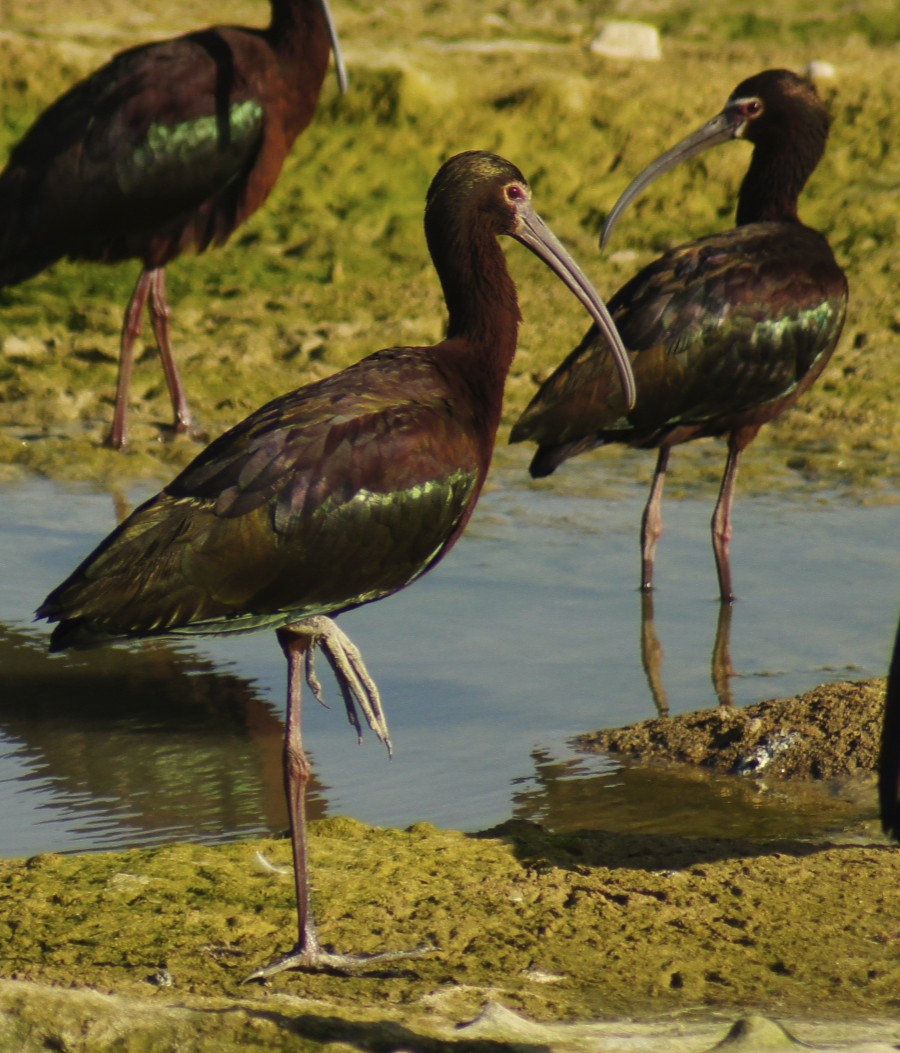
Until last week, the White-Faced Ibis were still shy, irregular birds in the Phoenix-area marshes. They stayed far away, were skittish, and their batteries ran out way too quickly, much like other Apple products.

Here's the older model: an amazing thing in itself, but not the finished product, not the final form.


With spring now getting off its fanny, Apple has introduced a new model. The iBis 2.0 seems to have replaced those timid, duller colored birds all around Phoenix now. Where there might have been two or three scrawny birds standing in the murk there are now dozens and dozens, with many more still flying overhead. They're shinier, they're hip, they combine the color and iridescence of songbirds with the ungainly and endearing frame of a wader. In short, these new iBis 2.0s are much more user friendly, and they've been great fun to observe.


It helps that there's been an algae bloom in lots of the recharge ponds around Phoenix too. These oft-desolate basins are now packed with color, even if it is an unearthly shade of green. Stare at this snapshot for too long and one might even feel like one's left earth altogether. If you do float off, not to worry, like other great Apple products, the iBis 2.0 has a nifty GPS.


The iBis are not the only birds sporting a new look and attitude. I was very lucky to see a Red-Necked Phalarope at the Glendale Recharge Ponds a few weeks ago, and now the same ponds are serving as a rendezvous point for little groups of Wilson's Phalarope.

Here's a pair of males enjoying some quality guy time as they chat about mustaches, engines, stock portfolios, etc.


Phalaropes are an interesting family of birds. They've taken the Sadie Hawkins Dance and turned it into a lifestyle with their typical gender roles reversed. The female Phalaropes are larger and more aggressive than the males. They also have much bolder plumage during the breeding season:


Just like at a Sadie Hawkins dance, the lady Phalaropes pursue and try to entice the males with their whimsical wicked wiles. Once they lay their clutch of eggs, the females depart and leave the males to incubate the eggs.

There were about two dozen Phalaropes at the Recharge Ponds on Sunday evening. This male arrived a little late to the mixer, perhaps due to his extensive application of rouge, but he soon integrated himself into the party.


It looked like they were having a charming little gala, but even Phalarope parties can get crashed, and in this case the crashers were some precocious Mallard chicks. It was kinda funny that the Mallard chicks were almost as big as the adult, breeding-plumage Phalaropes.

Monday, April 30, 2012

Short-Billed or just Short-Changed?

I recently photographed a small group of feeding Dowitcher. As always, I was on the look-out for a Short-Billed, having never conclusively found one before. One of the birds stood out from the pack this time. It seemed lighter and smaller than the other Dowitchers. Of course, none of those things in themselves prove it's a Short-Billed, but if anyone can venture a guess from these grainy photos I'd appreciate it.


I'm not getting my hopes up, but you never know...

Sunday, April 29, 2012

Thrushed with Orioles and Orioled with Thrushes


While out birding at the Botanical Gardens on Friday I had the pleasure of adding some new birds to my Garden list. Chief among them was a group of four Hermit Warblers foraging underneath a very large mesquite tree. 


Hermit is a good name for this skulking Thrush. Hermit Thrushes have a very pleasant, somewhat melancholy song and prefer to feed in the leaf litter underneath thick shady trees. They're soft, spotted, and polite, yet also fairly inquisitive within their small domains. I don't see them that often in Arizona, and their preference for shade can make them tricky to photograph. 
This first shot summarizes the bird well, at least in my experiences--close to the light but never fully illuminated. 


Like finches and sparrows, Thrushes have something very appealing in their simple yet unique and intricate plumage.


Here is the diagnostic rufus tail, the surest way to tell the Hermit Thrush apart from other, similar looking Thrushes.


They're compact and have good posture. They inhabit a small niche, but it's always a pleasure to enter into their world.


The Botanical Gardens were very crowded on Saturday, and it was hard to find any corner of the site with a little bit of quite and privacy. For the first hour or two I saw little of note. I was convinced there was someplace within the grounds where the birds might have retreated, some place where they were concentrated while trying to avoid all of the traffic. I don't know if there was anything to that theory, but I found a path of mesquite and palo verde trees near the herb garden tucked away from most of the other visitors, and sure enough there I found some new birds for my Garden list.

It was a near-overload of yellow and orange as a pair of Bullock's Orioles gleaned the palo verde blooms. It's safe to say that all Orioles are mouth-watering birds, and the Bullock's is a pretty classy specimen.


I've only had a few opportunities to photograph Orioles, and this was the first successful attempt, since this Oriole was thoughtful enough to do some quick preening out in the light. He gave me a great look at his diagnostic white wing pattern.


Not wanting me to have too much of a good thing, he quickly departed. Beautiful bird.


There were some small birds doing small bird stuff in a nearby mesquite tree. Upon closer inspection, most of them turned out to be Gnatcatchers and Brewer's Sparrows. My old photographic nemesis, the Wilson's Warbler, also made a quick appearance. This was my first time seeing one at the DBG, and I came very close to finally defeating this ornery yellow bird.


I even got most of the bird in focus, but of course OF COURSE there's a nice patch of shade obscuring the face. Ah well. Summer is just beginning and we'll meet again...mwuahahahaha.

Friday, April 27, 2012

Beautiful Birds, Clever and Clunky

Birds display all kinds of fascinating behaviors. Whether it's a Hummingbird trying to attract a mate or a Reddish Egret hunting in the shallows, birds seldom move without purpose, and never cease to intrigue with their antics.

When it comes to defensive parenting, Killdeer set the bar for behavior. When predators are near a Killdeer nest, the parents will often feign injury and try to draw them away. This clever bit of guile does not work on humans so well, but luckily we're seldom looking to eat Killdeer eggs. 

While I was observing some White Pelicans at Tres Rios, this Killdeer flew down and landed next to me, eager to draw my attention to its apparent vulnerability (never mind that I just watched it fly in next to me). 

I couldn't help but smirk. It was a very precious moment, and very endearing to observe, but maybe this was a first-year parent because the performance was not all that convincing. 

When the Killdeer wants to get a predators attention away from their nest area, they'll lay low to the ground and spread out their wings and/or tail, appearing to have a broken bone:

Once the predator takes the bait and moves toward the adult, the Killdeer will magically recover just enough to run a few more feet away, while still appearing injured. Ah, the bird has moved but it's still vulnerable, and so the predator follows after it, and the Killdeer repeats its deceptive pattern. It flies a bit and then lies back down again, looking hurt and weak and oh so delicious. Soon, the predator forgets all about those tasty eggs (hopefully) while pursuing the stricken bird. Eventually the Killdeer takes to wing again and leaves the predator feeling glum, knowing it was played for a sap. 


When the danger has been drawn sufficiently away from the nest or young...exit stage right for the Killdeer. Hopefully the predator doesn't remember his original plan.


Like a matador luring on the bull, goading it and using the bull's own instincts against it. 

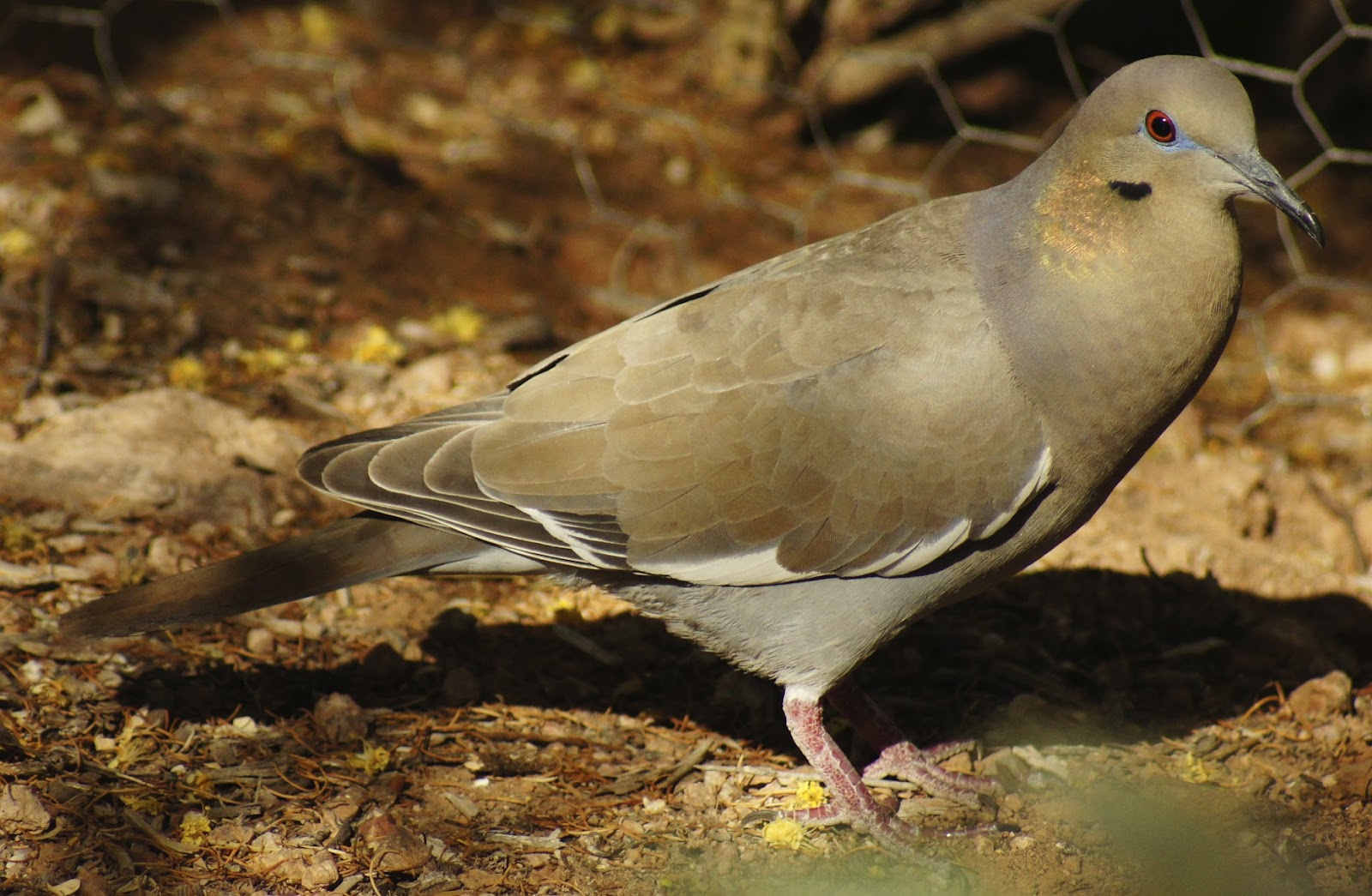
I must admit, Killdeer calls grate on my ears, but they're still handsome birds and are fairly clever. Alas, the same cannot be said for these White-Winged Doves that descend on the Phoenix area as the temperatures start to rise.


Like Mourning Doves, these White-Wings seem to have a look of unintelligence about them. Of course, the Killdeer teaches us that looks can be deceiving, but with these bullish Doves, there's not much sophistication in their behavior. Though common, they're nice to look at, and I like to see them mixing it up with the Mourning Doves. All the same, they're unsettlingly dumb. I've had to divert lawn mowers around the thoughtless birds as they sit in the yard. Once, I saw a pair mating in the middle of a 4-lane road. I guess I can't critique their methods too much though. After all, it's a successful species.

I took advantage of this Dove's characteristic space-out to snap some close-up photos at the DBG.

Tuesday, April 24, 2012

Sudden, Solar-Induced Lassitude!!

This cool looking dude is a Desert Spiny Lizard, so named because he lives in the desert and is spiny. Like all other reptiles, this modest dragon is cold-blodded, so he feels at his best when the sun is shining and his body is heating up!


I guess we all feel that way, to an extent. However, I must insert a strong caveat. I do not feel like that when it hits 104 °F and we're only half-way through April. Granted, it'll get much hotter in Phoenix as summer gets underway. Oddly enough, the 118 °F temps of August are more bearable, because they're expected. 
It is not often that I am compared to an Avocet, or that I make the comparison myself (though now that you mention it, we are both rather gangly...), but usually when I get out and birding, I start romping around and feel like a million bucks, much like this guy: 

  
However, when it hits triple digit temperatures in mid April, it can really dampen one's spirit (how that's for irony?). When that happens, I feel more like this guy, baked and bewildered:


All that complaining aside, I still enjoyed some nice birding this past weekend, even if my neck is now more crimson than the Red-Necked Phalarope so recently seen at the Glendale Recharge Ponds. The little pretty bird had taken the scorching heat as his cue to move on. Who took his place? Everybody's favorite Turkey of course!

"Hey guys, what's goin' on?"

For some reason, there were vultures everywhere. I counted 18 circling in the sky, and they were also feeling free to come in and land somewhat nearby, which in my experience is less common than one might expect. Vultures are well known for urinating on their legs. It serves the dual purpose of keeping them cool and killing bacteria. To answer your question, no, no I didn't try it myself.


These odiferous undertakers were not the only bird on display. There were some nice Cinnamon Teal out on the ponds as well as one Western Grebe and three Eared Grebes in full regalia. There were small groups of Dowitchers trying to find shade along the banks, and a few Cliff Swallows flying their erratic rounds with the usual vivacity, as if they were solar powered.

One of the upsides to the extreme brightness is you can get plenty of shutter speed. Of course, aiming and focussing quickly are still areas wherein my human error can exert itself : )
There goes a Long-Billed Dowitcher (someone please tell me if it might be Short-Billed), searching for a more private shady spot. 


This Cliff Swallow photo was actually taken near Tempe Town Lake, but the setting looks nearly the same and the picture is nothing special, so I'll shove it in here. I feel like in-flight Swallow photography must be the apex of photographic skill. This is perhaps the first time I've gotten a Swallow in frame and been able to tell its species. Progress!


There were Black-Necked Stilts and American Avocets doing their thing in the mudflats too. This particular Avocet seemed to be so proud of his breeding plumage that he'd show it off to anyone who cared to look. We can all relate.


He waded over near a Black-Necked Stilt, eager to showboat his rusty neck and remind the black and white Stilt that television and photography have been in color for years and years now, that the Stilt was behind the times.


He was looking pretty good, but the other birds didn't seem to be giving him due recognition. Soon, he decided he was too cool for that pool, and he moved on to a more suave watering hole. Can't blame him there.  


After seeing off the Avocet, I called it an early day and went to find a potable watering hole of my own. 

Saturday, April 21, 2012

Picking a Spot and Getting the Shot

I fit a pleasant hour of birding in at the DBG after work on Wednesday. The wildflower garden there is bursting with color, and as such is one of the few places where there is still substantial bird activity, even when it's 94 degrees outside.

Overbearing sunlight and a bit of laziness compelled me to just pick a spot and plop down for my time at the DBG. It worked out pretty well though. The birds soon felt comfortable and were pretty close. There was a lot of stuff in the way, but I had obscured views of Green-Tailed Towhees, Gilded Flickers, and a lovely MacGillivray's Warbler. I also had some nice, clear views of many birds, and the added bonus of pleasing scener made it a very nice session of photography.

This Curve-Billed Thrasher was foraging underneath an ironwood tree (my beloved source of shade). The dry, yellow leaf littler all around reminds me of cornflakes...wouldn't he love to be standing on a big pile of those!

I've often thought that Cruve-Billed Thrasher beaks are superfluously insidious-looking. They're very functional, of course, and help the birds dig into top soil and pry under the leaf littler in search of food. But lots of other birds accomplish this too, and without looking so dangerous. I bet the Thrashers are hiding something, like they are, in fact, raptors in disguise.


The Gardens are still buzzing (quite literally) with Hummingbird activity. There are Anna's Hummingbirds at all different stages of molt and maturity, constantly bickering and chasing each other away from the flowers, never having enough time to actually enjoy the prize themselves.


This young male was a bit more subdued. He had a nice shady perch and was content to let the other hummers fight to the death, perhaps planning to claim the whole Gardens as his domain once the competition had eliminated itself. Whatever his plan, part of it seemed to entail sitting right next to me. I actually had to zoom out to fit him in the frame. How often does someone get to say that about a hummingbird? I would've liked a tiny bit more light, but I was still  very pleased.


The Thrasher was on the ground, and the Anna's sat near the top of the shrubs. This female Phainopepla seemed to like life right in the middle. She was often obscured from view, and didn't seem to be too comfortable squirming in between the brush. I suspect she had a nest nearby, but I could not find it.


She lowered her crest and she is about to take flight--always good to maximize aerodynamics.


I returned to the same spot in the Gardens on Friday evening, this time with family, as we all set out to enjoy the blooming gardens in the cooler evening temperatures. We toured the whole facility, and also made a specific stop in the same place, and again I was rewarded with some nice photographic settings. The sun was on the wrong-side of this House Finch, but his red body surrounded by yellow palo verde blooms still made for a nice composition:


He made it look pretty good. I wish I could eat flowers.


This grumpy Curve-Billed thrasher was one of the few birds tolerating the direct sunlight. He seemed to be guarding this net-covered yucca plant, and was determined that it remain concealed until its grand unveiling, whenever that may be.


But even the most stalwart sentries still need to blink, and this Thrasher was no exception. In this photo, the nictitating membrane is still visible, as only half of the eye is fully exposed.


It's nice to just sit and bird in one spot. I'm often too impatient and end up roving all over a site. I know I probably see less birds that way, and definitely get less photos, but it has the psychological bonus of making me feel like I'm doing something, like the number of birds I may see is actively within my control, even if that's not the case. Nonetheless, every time I just pick a place and wait, it's just as rewarding.