Sunday, February 5, 2012

Finding Some Pep at the Rio Verde

This morning I went out to the Box Bar wildlife-and-walkin'-around area at the Rio Verde, a nice little river running down the east side of Phoenix. The drive out through Pima was pretty nice too. It's that time of year when the rustic desert foliage is also joined by the green grass and wildflowers to create a very impressive collage of color. I met up with the family near the river, and we enjoyed each other's company as well as a quiet and cool mid-morning of birding.

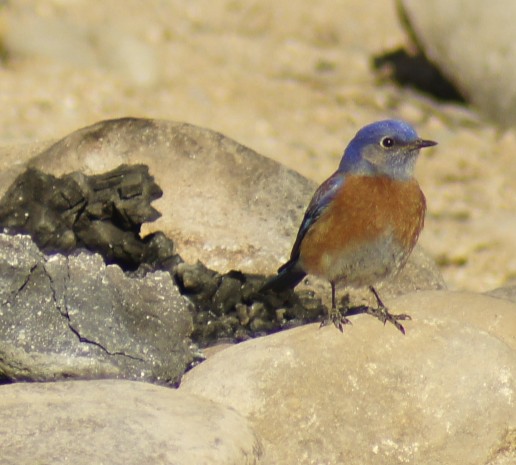
We saw some Western Bluebirds, plenty of Yellow-Rumped Warblers, plenty of Black Phoebes, some Herons, some Red-Tails, and a possible pair of Hooded Mergansers (which took off immediately).

The main goal was to see a Phainopepla, a peculiar dark species of flycatcher that prefers the arid Southwest and can be found in pockets throughout the southern half  of Arizona. In rather unceremonious fashion, my first sighting came off of a telephone wire while I was still several miles from the hiking area. As I got nearer to the Rio Verde turn-off the sightings began to increase, and eventually I pulled over and began some highway-side photography because the desert just seemed to be bursting with Phainopepla activity, and you've gotta take what you can get. It was awesome!

This was the fourth Phainopepla I saw, and the first I was able to photograph. They're in their own group of silky flycatchers (I suspect they have some tropical cousins that also share the group), which must in part refer to their glossy shine and elongated anatomy. I love how slap-dash the crests are on these birds. It's clearly a crest, but it looks like it's losing the war with bed-head.


It was difficult to catch the male's ruby-red eye at times, but boy when it got some sun that thing could really radiate!


While I was calling and whistling to this male (for no good reason really, it's just fun to imitate), this lovely female came by to investigate. It was probably not my calling that brought her in... in fact I'm sure it wasn't. What is apparent from this first picture is that she felt nature calling, and she discretely deposited her morning meal before flying over to her beaux.


I was geeking out pretty badly at this point, you know with the whole talking to yourself and exclaiming "Woah! No Way!" inhaling only to realize you haven't taken a breath for like the last 3 minutes. It was only a half-hope to see them in the first place, and now I had multiple Phainopeplas within camera-shot. With her solid grey, white wingbars, and striking eye, the female is a visual feast just as well as the male.


That being said, some angles flatter the birds more than others. From straight on the Phainopepla crest gives the bird a very rectangular head shape, one that reminded me a little bit of Frankenstein's monster.


After a little bit of flirting and playing hard-to-get, the female joined the obsidian male in his tree, where he continued to serenade and impress her with his silky-smooth moves.


I like to think that I brought them together. In all likelihood though, my presence was keeping them apart. I left them to their romance, myself feeling very satisfied and simply in awe. As I continued the drive down to Box Bar I saw some 7 or 8 more Peplas living it up in the morning sun. What a great way to start the birding day!


Friday, February 3, 2012

Some Power Birding

I snuck in a quick bit of birding this evening after work. I have been trying to relocate a Common Yellowthroat I saw a while back (a current photographic nemesis) at the Tres Rios preserve in south-central Phoenix. While I was again unsuccessful in that regard, it was a nice walk around with plenty of other fun and common birds.

This Great Blue Heron was hanging out on the water's edge in those nasty red vine things. I don't know what they are, and I'm sure they're a biologically impressive species, but they remind me of the vein-like things that the aliens use to digest the earth in War of the Worlds. The Heron was cool though; he didn't seem to mind. By the way, should we call a female Great Blue a Heroine?


I've been trying to improve my in-flight photography (when the bird is in flight, not myself). Slowly but surely I'm learning things about better settings and when/how to anticipate take-offs. It's a good challenge, and the big lumbering herons make pretty easy subjects for beginners such as myself.


I still haven't glimpsed that ruby crown, but otherwise the Kinglets have been great this year. They're hanging out around Phoenix in large numbers and with very little shyness. Now, taking their picture without obstructing twigs is another matter entirely.


The Verdin is one of the signature species of the arid southwest. Like the Kinglets, they're pretty personable and pretty good-looking. I'm been having warbler envy this winter, but the Kinglets and Verdins and Yellow-Rumps are doing their industrious best to keep me satisfied. Thanks guys.  

Thursday, February 2, 2012

Flycatcher or Phoebe

I know, a Phoebe is a Flycatcher, but I've always been a sucker for alliteration.
Anyway, these two photos were taken in late summer at the McCormick ponds in east Phoenix. There were a pair of Vermillion Flycatchers, one male and one immature, flying among the palo verde trees looking for bugs. They mingled with Yellow-Rumped Warblers, a Black Phoebe, and a Say's Phoebe. None of them actually seemed to be enjoying each other's company, but that could've just been the competition for those yummy gnats.

It was only reviewing these pictures later on that I noticed how oddly similar an adult Say's Phoebe is to a juvenile Vermillion Flycatcher. Can you tell which is which?


Snow Goose

The Snow Goose is a medium sized white and black goose that is most well known for its massive breeding populations up North. They migrate south for the winter, and can often be found in huge congregations. They're casual visitors to Arizona, which is largely out of their normal range, but there's always a chance you'll see a couple mingling wherever else geese are found. There was a vagrant pair out in the middle of the Gilbert Water Ranch ponds this last Saturday.


These are the first Snow Geese I've seen in the state, and the first I've had an opportunity to photograph. With the noon-time sun beating down on these alabaster birds, I decided to try a new route in photography. I don't normally use any sort of image manipulation, other than cropping, when I process photos. But since I couldn't get rid of the sun's white-washing effect, which almost makes the Geese glow purple in pictures, I just went black and white.

Black and white photography is most often used to make classy portrait shots. It is also used by artsy kids in tight jeans who take pictures of dilapidated lawn chairs and rusty bathtubs to make themselves look brooding and contemplative. I'm not crazy about the result here (and not just because it's blurry), but at least the species is discernible, and not engulfed in a purple hue, which is even less natural.


*I found and photographed these Snow Geese and Ross's Geese (2 and 2) several weeks later in Glendale.


Tuesday, January 31, 2012

Liminal Birds

Liminal is a nifty word that describes the border between two different things, be they cultures or environments. The liminal space is where elements of both overlap and interact, sometimes harmonizing and sometimes coming into conflict.

Many birds seem to prefer the liminal spaces of nature. I certainly gravitate towards these areas as a birdwatcher, probably because it's easier to see and target places that have lots of distinction. It's much harder to make oneself survey a homogenous landscape than one with many different features on which you can easily focus. Observe the liminal spaces at the Gilbert Water Ranch, those areas where land meets water, where the chaparral meets the trees, and these are some of the species you'll likely find:

The Northern Shovelers are not very good divers, but they do like to feed off of the bottom of ponds. As such, they're limited to the shallow areas where they can go bottoms-up. Locating Shovelers in a pond is a good way to guess at the depth of the surrounding water.


 The Black-Necked Stilt is not a swimmer, but it likes to feed in the mucky muck just like the Shoveler. Consequently, it too is destined for life in a liminal space.


The Common Gallinule (formerly known as Moorhen) makes its nest in the reeds and bullrushes around the water, and is seldom seen very far away from its precious cover. I'm not really sure what they eat, but if if it's true that you are what you eat, then looking at the beak I'd say they eat candy-corn.


The water's edge draws all manner of other birds, including warblers, wrens, waterfowl, herons, kingfishers, and shorebirds ad infinitum. There are also many birds that prefer the dryer liminal spaces. The Sparrows and Finches in Arizona like to move between the higher trees, which provide more cover, and the seedy grasses that provide better but lower foraging. I found my first ever Lawrence's Goldfinches moving between the trees and grasses at the Water Ranch, and they were also accompanied by lots of Brewer's Sparrows.


My fondness for these margins sometimes inhibits my birding. I often spend too much time looking at these areas, which can attract many different species of birds, and miss the less conspicuous specialists who stay in a specific environment. But hey, whether you bird in the margins, or immerse yourself in one specific environment, it's all good. Birding is fun.

Monday, January 30, 2012

Inca Bink a Bottle of Ink

With a relatively small range (for a dove) that does not much exceed the southern parts of Arizona, California, New Mexico, and Texas, the Inca Dove has much less of an empire than its now-extinct namesake. However, they did outlast the Incas, and they have no scarcity of competition from larger doves or grackles either. 


Their feathers have a scaled look to them that encompasses their entire body, unlike other semi-scaled birds such as the California QuailTheir soft call and mild manners makes them a pleasant addition to the typical batch of Southwestern birds one might see making a ruckus about the feeders, and they're certainly my favorite dove.


I like their eyes. Unlike other, larger doves who seem to always have that vacant stare, the Inca Dove eyes seem to have a slight glimmer of kindness and gentleness behind them. With their gray dimpled plumage and endearing politeness, these are grandma birds if there is such a thing.


I found this nice pair at the Gilbert Water Ranch on Saturday. They were being very cozy-cuddly and didn't seem to mind the interlopers as they scratched and stretched away the remnants of their afternoon nap.


Sunday, January 29, 2012

Lemme Teal You Something Buddy!

I've had a wonderful time finding and photographing the various wintering waterfowl here in Arizona. The Shovelers, Pintails, Ring-Necks, and Scaups are all beautiful and pretty easy to access in the city. The Teal group has been much more challenging. I've not seen any Blue-Winged Teal this winter, and the Greenwing-Teal like to stay far out in the Gilbert Water Ranch Ponds, as do their much less numerous Cinnamon cousins.


I've spent a lot of time trying to improve my Teal cache, and have found them to be both entertaining and tricky subjects. This Teal was by far the most proximal of all the Teal I photographed. However, his exposure came with a strong condition; he wasn't exposed. By this I mean the stubborn duck kept his beak and part of his face underwater with more determination than a squirrel trying to infiltrate a bird feeder.

He wasn't sitting still either. He would actually scoot along the shallow water, pacing back and forth like an adorable little vacuum sucking up all the lovely bits of filth he could.


At 30 to 35 yards, this is the closest I've managed to get to a Cinnamon Teal. I don't know much about it, but of all the wintering waterfowl that are not actually rare visitors, the Cinnamons seem to have the most limited range. They're the only duck I've seen exclusively at the Water Ranch (though the Ranch is the only place that brings all the ducks together so splendidly), which means I can't count on finding them at the other smaller urban ponds for a close up. More patience is required.


Here's another Green-Winged Teal being all tealy. They combine the facial markings and colors of both Pintails and Wigeons. I agree, and in fact there's a lot in their torso that resembles the Pintail as well. They're very pretty ducks. It seems to have been an unusually warm and short winter all around the country. It's not over yet, but many of the birds here in the valley seem to be prematurely starting their breeding and nesting. I hope for a little more time with the Teal before they return to the northern climes.

Thursday, January 26, 2012

Mock-YEAH Ing-YEAH

Bird-Yeah. This guy was hanging outside my classroom window after school. I like the afternoon light, even if it's the early morning light that is ideal. There's quite a lot of brown in this picture.


There's not enough of the eye visible, but I like all of the texture in the shot. It was a nice concatenation of lighting and placement. This lower photo of another mimid, the Catbird, was taken at about the same time of day in Pennsylvania (in late spring). There's a pretty noticeable difference in the color of evening light along the United States.


Wednesday, January 25, 2012

Wednesdays with Audubon, Chapter 9

As a matter of manners and thanks, Audubon and his men conducted some business on Magdalene island before departing. They bought over-priced, low quality animals skins (in Audubon's developed opinion), a few other provisions, and proceeded along the archipelago about 18 miles in search of nesting Mergansers and Geese. Along the way they stopped to collect Black Guillemot eggs, which turned out to be quite an undertaking. The birds lay their eggs on bare coastal/cliff rock, just above the high-water mark, and are very staunch defenders of their nurseries. It's a fun image, these heavy-laden sailors slipping and sprawling on the wet and poo-plastered rocks as the cold waves break and spray with the protesting birds.


Before they reached the waterfowl lakes on the eastern extremity of the Magdalene Archipelago, the Audubon crew caught a very favorable wind towards Labrador Island, and they changed course without much debate. Their new heading took them into line with the many trails of Gannets all heading to some unseen breeding ground. Some of them hung noticeably low in the air, no doubt gorged with fishy bits for their waiting mates and young. The birds were heading towards a large, snowy monolith that rose out of the churning water. As the men drew closer, Audubon realized with great elation that it was not snow at all which covered the rock, but Gannets. Thousands and thousands of Gannets:

"I rubbed my eyes, took my spy-glass, and in an instant the strangest picture stood before me. They were birds we saw--a mass of birds such a size as yet I never before cast my eyes on. The whole of my party stood astounded and amazed, and all came to the conclusion that such a sight was of itself sufficient to invite any one to come across the Gulf to view it as this season."


To Audubon's dismay, they were unable to bring the ship/row-boats in close enough to land on Gannet Rock. After a few dangerous and futile attempts, the mournful crew pressed on. Many of the men spent the next few days in a state of poor health, no doubt brought on by their fool-hardy pursuit of the Gannet roost in cold and stormy conditions. They sailed on through the rain and reached the island of Anticosti on June 15th. They spent the 16th recovering and fishing for cod, and at 5 am on June 17th they first sighted the shores of Labrador.

Thousands of Razor-Billed Auks and Velvet Ducks (Velvet Scoter) escorted them in towards the island, and they soon found a harbor where several Hudson Bay Company fishing boats were moored. After saying hello to a few friends, they continued on to an American harbor. When they dropped anchor around latitude 50, it was farther north that Audubon had ever been before. Despite this auspicious beginning, the initial explorations were somewhat disappointing. The island was covered in a thick, spongy moss that spread over any and all exposed earth. The trees were haggard and wiry, presenting only a single Pigeon Hawk as game for the men.

They continued to sail around the island and made anchor again at noon, where Audubon gathered specimens of Eider Ducks, and began to catch up on his neglected drawings, before his previously gathered specimens started to spoil. It has been a trip of mostly pelagic sightings so far. I'm sure that Audubon and his crew were eager to spend some time ashore, and so am I.

Sunday, January 22, 2012

Warbler Envy at Rio Salado

I've had warbler envy lately. The definite focus in Arizona is the wintering waterfowl, but now I find myself yearning for those flighty tweety birds too. One can always count on the Orange-Crowned and Yellow-Rumped Warblers in Phoenix in the winter, but to diversify one's sightings beyond there requires some work.

I had stopped off at the Glendale Recharge ponds on Saturday in  the vain hope of seeing a reported pair of American Redstarts. While I did have a nice time looking and conversing with other birders there, we all struck out on the birds themselves.

Next I decided to check out the Rio Salado Audubon center that's in south-central Phoenix. I had visited this center in the summer and seen some Wilson's Warblers, along with some Green-Tailed Towhees, but hadn't been overly impressed. There had been recent reports on the AZ listervs though of Black-and-White Warblers, Myrtle Warblers, a Summer Tanager, and some Redhead Ducks--all new birds for me--at the center now, which was more than enough motivation for me to get outdoors instead of grading papers.

While I did not see any of the above species, I did get some good looks at Common Yellowthroat, Marsh Wrens, Kinglets, and Lincoln's Sparrows. My photographic nemesis the Common Yellowthroat continued to elude my camera. At one point I thought the curse might end, but then a large loud family passed by making as much noise as possible, and all of the birds flushed. Arrgh.

I did see a male Black-Throated Grey Warbler from far away, the first male of the species I've seen, so it was still a pretty good outing, even with the heavy clouds.


Here's the namesake black throat, which is not actually visible on the female.


Like most Warblers, he stuck around for all of 3 seconds, and then took off.


Here is a more aesthetically pleasing shot of the female Black-Throated Grey I saw this summer at the Gilbert Water Ranch. Note the non-black throat.