Thursday, January 19, 2012

Lawrence's Goldfinch

Even though the Lawrence's Goldfinches spell their name incorrectly, there was still a special satisfaction to seeing and photographing this semi-kindred bird. The reports started circulating on the AZ listservs that there were a few Lawrences around Pond 5 at the Gilbert Water Ranch. They're not exactly rare, but they're uncommon and move somewhat erratically, so it's hard to predict when or where one might get another chance to see these handsome little birds.

It took a while to locate them at the Ranch. The Lesser Goldfinches that I see around the area like the tops of the thistle and seedy grass. I figured the Lawrence's would act similarly, but this wasn't exactly the case. It was odd enough that I didn't see a single Lesser Goldfinch, and the Lawrence's turned out to be mingling with White-Crowned and Brewer's Sparrows in the southwestern nook of Pond 5. They'd spend a minute or two up in the mesquite trees, and then return to forage fairly low in the grass, like the Sparrows, and spend 30 minutes or so in the ruff.


They were hard to find in the grass, and harder still to keep in focus with the camera. It was a pretty charming and fun challenge as they were not overly bothered by my proximity, and I was forced to practice my manual focussing. As undesirable as it is to have the grass obscuring the bird, I like the overall effect and texture that the spindly stalks bring to the photos.


I did want to get a clear photo though, and after a pretty long spell of waiting, the Finches finally returned to their mesquite perch. However, when a thick cloud moved in front of the sun, it made for a pretty nervy ending. I was starting to sense that the Finch's patience and my luck were running out. As you can see below, the cloud eclipsed almost all of the natural light. The Finches were sitting still for now, but how long could they last!? It was a race against time...


The cloud cleared away just in time. I got a bit of light and got a few shots off before the Finches bolted, and not just back to the field. They took off across the pond and quickly disappeared. Even if the photos aren't picture-perfect, I got to observe the Finches for a long and edifying time. It was a very fun and thorough way to add a new bird to the List, and keep the good times rolling in 2012. 

Wednesday, January 18, 2012

Wednesdays with Audubon, Chapter 8

After a somewhat slow and shaky start, Audubon and his help were making their way through the Labrador Islands and towards the gulf of St. Lawrence. Some of the islands were dotted with rundown shacks and smokehouses. The boreal air held a heavy stillness that wass only occasionally broken by the call of some pelagic bird echoing through the misty sky. Apart from the occasional sighting of a fishing boat, the men were isolated. It must have been eery and unsettling at times, while wonderfully freeing at others.

On June 11th they passed through Cape George and Cape Porcupine, where the ice was still well-formed. They stopped near the Porcupine shoreline to trade with some Indians, and Audubon also came upon some Chimney Swallows and Blue Jays.


The St. Lawrence Gulf was a bit more settled than the outer islands. Little hamlets dotted the emergent green hills as they undulated into the distance, textured here and there with the recognizable rows of cultivation. Audubon and his crew put in at Jestico Island, which was speckled with wild strawberries and enhanced by the flurried activity of American Redstarts and Tawny Thrushes. About the Redstarts Audubon writes: "This is one of the most lively, as well as one of the handsomest, of our Flycatchers, and ornaments our woods during spring and summer, when it cannot fail to attract the attention of any person who may visit the interior of the shady forests."

They also observed mating pairs of Spotted Sandpipers, Guillemot, and Great Blue Heron. 
They collected black currants and the sailors killed a seal for dinner, while Audubon observed a pair of Red-Breasted Mergansers, "that had glutted themselves with fish so that they were obliged to disgorge before they could fly off."

June 12th was spent navigating from Cape Breton to the Amherst Islands in very heavy fog. Despite his father's prowess, Audubon was not much of a sailor. He spent most of his time sullenly below decks while they navigated the tricky sandbars that often linked the tiny isles. On June 13th the temperature dropped down to 40 degrees, a dip for which Audubon and his crew were poorly prepared. They went ashore Magdalene Island where they were met on the beach, much to their surprise, by a wild-looking woman who spoke about a third French, a third English, and a third of some other jargon Audubon claims neither he nor any of his crewmen could decipher. The woman nonetheless led them to a small Catholic Church, where, to their surprise, they were caught up in the middle of a La Petite Fete de Dieu (translate 'small party of God'?) festival. Despite the harsh conditions of the island and the apparent poverty of its populace, Audubon & Co. were treated to French wine and fresh herring. While the less ornithologically inclined made pleasant company inside the chapel, Audubon followed the preliminary rays of sun out into a nearby wood. He observed "Black-Capped Warblers" (I'm not sure if this would be a Black-Capped Chickadee or Black-Capped Vireo?), and Audubon gathered his first specimens of Piping Plover.


Audubon recorded: "So plaintive is the note of this interesting species that I feel great aversion to killing them. They are also the swiftest of foot of any water-birds, which I know, of their size." 
He later added in his Birds of America, "While migrating eastward, the Piping Plovers proceed in pairs; and should one of these on its way find a convenient place for breeding, and remain there, several others are often induced to take up their abode in the neighborhood."

It's not one of my favorite illustrations, but he gives a pretty charming account of the birds. I wonder what sorts of joy Audubon would have found with a digital camera on these expeditions, the greatest advantage of which is that it would spare the birds? Of course, one could argue that Audubon would be able to paint from photographs and memory, but what if that were not an option? I wonder, if he were forced for some reason to choose between photographs and his painting, which would he pick? As I've said before, there's something irreplaceably more personal in these painted renditions of the birds, even if they're only second-hand likenesses.  

Tuesday, January 17, 2012

Birds at the Ranch

The good birding and open spaces at the Glendale Recharge ponds only increased my avian appetite in this long weekend, and I decided to revisit the Gilbert Water Ranch to search for some reported Lawrence's Goldfinches on Monday. I'll relate that adventure with more detail later in the week. 

As usual, the Water Ranch was teeming with activity and with all manner of species, from Herons and Kinglets to Teals, Stilts, and Sparrows. One of the best sightings came early on in the day, and coincided with a nice break in the clouds. I was circling around Pond 5, on of the larger and southern basins that is actually now full of nice, seedy grass (perfect for finches), when this female Northern Harrier touched down.


At about 25 yards, this was the best look I'd yet been afforded by a Harrier, although I see them flying around often enough in these winter months. This same female has been at the Water Ranch since at least October, and was actually the first of the species I ever saw. I continued around the southern bend in Pond 5 and was greeted by the unmistakable trilling of a Belted Kingfisher. He was as skittish as ever, but looked marvelous out in the sun. Magnificent bird.


I continued to peruse the grassy areas and shoreline scrub in search of the Lawrence's goldfinches, and was surprised to find not even a single Lesser Goldfinch, usually a guaranteed sighting at the Ranch. At least the herons were out in force. The Black-Crowned Night herons were in exactly the same place where I saw them a over a month ago. It is entirely possible they haven't even left the tree since then.


There were some Snowy Egrets in the trees as well as a Great Blue Heron. I like the protruding feathers here and the dexterous position of the Snowy's feet on the branches.


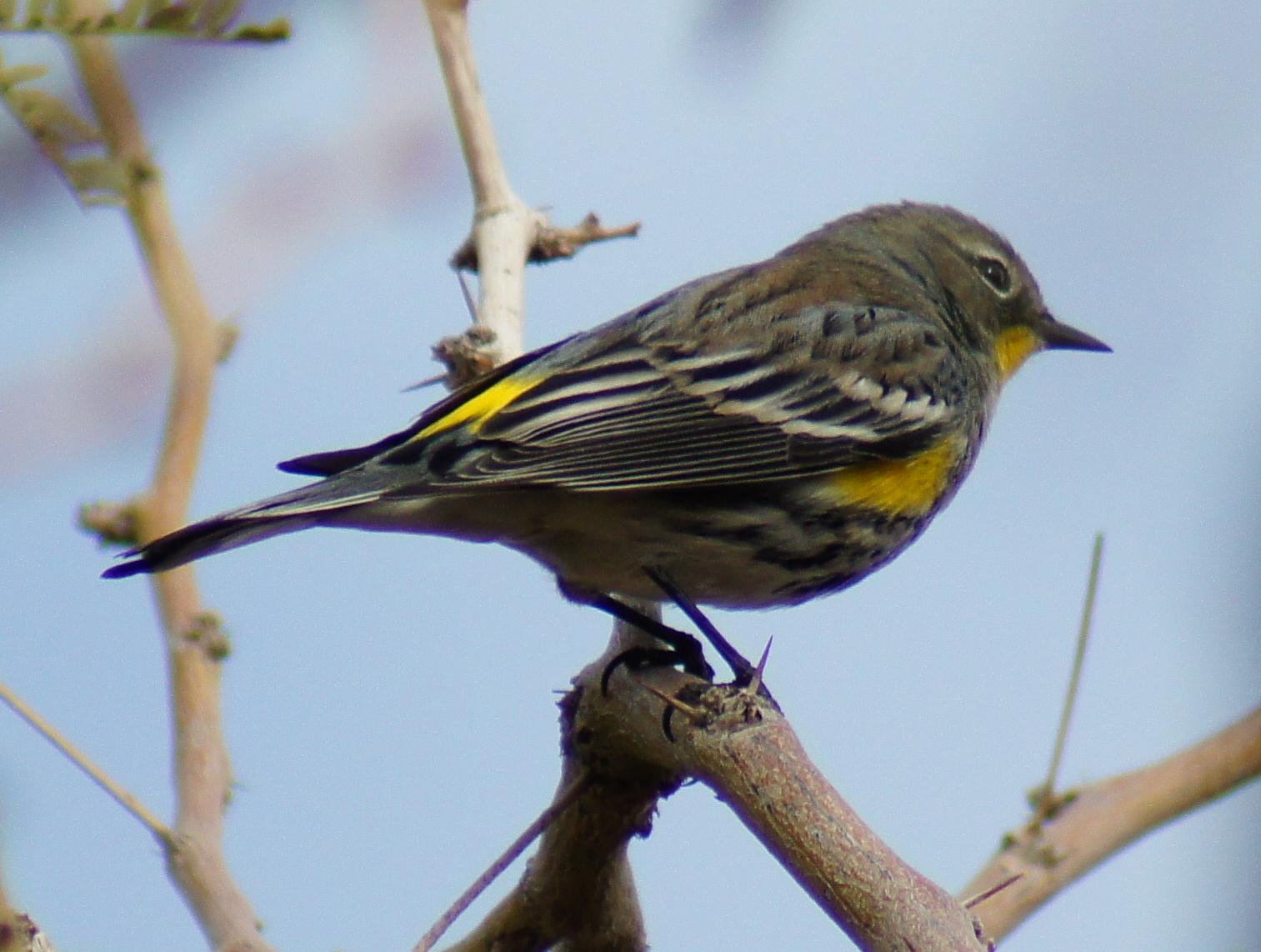
There are usually some warblers to be found in this swampy corner too, and I was hoping for the Common Yellowthroat I saw last time. Unfortunately this Yellow-Rumped was the only Warbler on duty, but even with them being a dime-a-dozen in the winter, they're still always a pleasure to see.


Slightly more muted was this sulking Brewer's Sparrow. If he was hoping someone would come and perch with him, he certainly didn't pick the most comfortable spot.


There were lots of Brewer's Sparrows along with a few Lincoln's and tons of White-Crowned foraging in the tall grass along Pond 5, and it was here that I began to vigilant wait for the Lawrence's Goldfinches. Since tomorrow is Wednesday with Audubon, I'll have to wait until later in the week to share that adventure. 

It was great birding at the Ranch, as always, and a very nice cap to the long weekend.

Sunday, January 15, 2012

Recharging the Birding Fun at the Glendale Recharge Ponds

I don't know what it is this winter, but the clouds seem determined to congregate only on the weekends.  It was a fairly mild Saturday morning birding in Tempe, so today I decided to check out the Glendale Recharge ponds on the west side of town despite the weather. The Glendale ponds are operated by the SRP electric/water company and have varying water levels throughout the year. Their wider diameter and relative seclusion from the city noise makes them an ideal location for wintering waterfowl, including Goldeneye and Buffleheads, two ducks I've yet to see.

The recharge ponds are sandwiched in the no-man's land between the Glendale municipal airport and the new NFL stadium. There's a lot of big and important air traffic going in and out of Glendale, lots of messages to send...


Alas, this was the only Cardinal that I saw today.


When I arrived, I was a bit discouraged to see that the water levels were in fact very, very low. This meant I wouldn't be seeing many ducks, but it was also a boon in that I could now traverse much closer to where the birds were feeding out in the muck. With high water, you obviously have to keep to the banks, which reduces one to scope/binocular views only. Although it was very overcast, I probably would not have gotten good pictures with high water levels and good sunlight either, since everything would've been so far away. Given that the cloudy skies seemed to really encourage the birds, I was happy enough with the circumstances. But be forewarned, dear reader, this will be a very brown and muddy post.


There are about 6 ponds in total, and although they were all similarly drained, there was still an abundance of waders, peeps, and shorebirds out in the gunk.
The first bird of the day was a Greater Yellowlegs, and he was spending his Sunday savoring the last puddles of swamp. Although he was alone, there were maybe 16 Yellowlegs seen in total, and for the most part they were the largest waders around the ponds.


The Least Sandpipers were definitely the most numerous. I stopped counting after I passed 150; they were all over the place. I'm not sure if this little guy was looking for food or just admiring his reflection. It made me think though, how curious it must be to see one's reflection every time one goes to take a bite of food, to have to peck through one's own countenance for every tasty morsel.


At the opposite end of the size spectrum, there were probably a dozen Great Blue Herons perched on fences and in the trees around the complex. I didn't see a single one down in the ponds, probably because the lack of water meant there was a lack of fish.

With the water levels being so low and the ponds so wide, I decided to start cutting straight through instead of walking around the basins. The idea was both to save on time and to get some better looks at whatever was in the middle of the ponds, where the little bit of water still remained. This plan also had the advantage of keeping what little sunlight there was concentrated behind me, though it had the disadvantage of covering my shoes in smelly mud. It worked out pretty well, and I was able to add two more birds to my Life List that I would have likely otherwise missed.

That is not to say I came away with dynamite photos or anything. Believe it or not, there are 5 Horned Larks hanging out in there, and believe it or not they were quite beautiful. I had been expecting to see some Horned Larks this winter, but was not really expecting to find them in the middle of a drying lake bed, so even despite their skittishness it was a very pleasant surprise. It seems like a new bird sighting and good photos seldom go hand-in-hand anyway, so there were no hard feeling as the Larks kept their distance.


There were a lot of American Pipits running around the pond interiors as well, and they too were a new bird for me. Though they stayed in constant motion, they were more self-confident than the nearby Larks and Sandpipers. Pipits seem kind of unremarkable, like a cross between a Song Sparrow and a Yellow-Rumped Warbler instead of being a clear and unique species. Their tendency to flick and wag their tails, and their longer thumb/rear toe sets them apart.


Even though I wasn't anticipating any Pipits, they're pretty common in the right habitats, and they gave me frequent sightings throughout the morning. As with many of those little brown birds, there's still a lot to appreciate in their muted plumage.


While I was ambling around the northern-most ponds, a single Sandhill Crane flew overhead. At least, that's what I thought it was. The long legs hung out behind the lanky bird and it had a much stubbier beak than a Great Blue Heron. I couldn't make out any color on the bird though, and I still don't feel confident enough to write it down. As I set out in pursuit of the possible Crane, hoping it'd settle in the nearby farmland for some grazing (it didn't), I almost stepped on this Rock Wren.

He flew away and then stood very erect and very indignantly with his back towards me, letting me know that we were no longer friends.


At this point I had surveyed most of the ponds and the nearby farmland, which was inhabited entirely by Blackbirds and Mourning Doves. Perhaps the largest overall attraction of the day was the selection of Raptors that were hanging out on the outskirts of area. In addition to the basins, there's an adjoining (and unfortunately off-limits) flood/overflow-zone with a small stream and lots of higher trees and shrubs that were very popular with the bigger birds.


I followed this riparian area south while heading back to the car, and that last 30 minutes of birding yielded 6 Red-Tailed Hawks, 2 Cooper's Hawks, 1 Sharp-Shinned, 2 Osprey, and 1 Loggerhead Shrike.There were also abundances of Chipping Sparrows, Song Sparrows, Yellow-Rumped Warblers, Abert's Towhees, House Finches, and Gnatcatchers along the stream, and I could hear Kingfishers calling even though they stayed out of sight.


The last bird of the day was this smaller raptor (maybe 14 inches), who was perched on the telephone pole where I had parked. She took off right as I raised the camera and the resulting photo is just blurry and dark enough to end the day with a question mark. My original guess was a juvenile Sharp-Shinned Hawk, but I think it may actually be a Merlin.


The cloudy weather is supposed to hold through midday tomorrow--when I was planning on exploring the Gilbert Water Ranch for some rumored Lawrence's Goldfinches. Let's hope those clouds have a bust up and decide to part ways!

Saturday, January 14, 2012

No Saturday Sightings

Pops and I set out to the Tempe Town marsh this morning, hoping to see the Northern Parula and Eurasian Teal that were spotted there earlier in the week. It was a brief but nice morning, with tons of Cormorants, Phoebes, Ospreys, Flickers, and Song Sparrows enjoying the weather. Although Pops had a brief but good sighting, I did did not see the Parula, and we both struck out on the Eurasian Teal. There were lots of Shovelers, Gadwall, and a few Green-Winged Teal to be seen, and we'll definitely try back soon for the others.
I'm hoping to check the Glendale recharge ponds out on Monday and comes back with  few more pictures--the photography was slow today. In the mean time, happy birding to everyone this weekend!

The sticks in fron of the Yellow-Rumped Warbler are very distracting, but I like the picture because you can see all 3 of the yellow point son the bird (chin, flanks, and rump).

Here's a darker male:


There's a juvenile White-Crowned Sparrow somewhere in there...

Wednesday, January 11, 2012

Wednesdays with Audubon, Chapter 7

The next several posts will focus on Audubon's trip to the Labrador Islands, one of the most dangerous and important voyages in his career. After the fairly successful publication of Audubon's Birds of America, it was essential that he quickly gather more and new species to document before he lost momentum. That is, before his name ceased to be the toast of England and the Ornithological world.

Audubon departed for the islands with his younger son John and a hired crew in early June of 1833. He chartered a private schooner called the Ripley for $350 a month plus provisions, and spent the summer months exploring, collecting, drawing, and painting in the near-constant daylight that such latitudes provide that time of year.


The first few days were spent in some apprehension as they struggled to pull the boat out from open water and into the numerous bays and inlets of the Labrador coast. The choppy waters and rocky shore were discomforting for the crew. On June 8th they successfully navigated the bay between the Seal Islands, known for their fur seal populations, and the Mud Islands, known for their mud pies. Audubon observed the nesting Storm Petrels and also collected specimens of Foolish Guillemot and Gannets, despite sea-sickness stealing everyone's appetite for the day.

Audubon recorded this about the Guillemots in Birds of America: "While on my way toward Labrador, they were constantly within sight, gambolling over the surface of the water, the males courting the females, and the latter receiving the caresses of their mates. These would at times rise erect in the sea, swell their throats, and emit a hoarse puffing guttural note, to which the females at once responded, with numerous noddings to their beaux. Then the pair would rise, take a round in the air, re-alight, and seal the conjugal compact; after which they flew or swam together for the season, and so closely, that among multitudes on the wing or on the waves, one might easily distinguish a mated pair."


The next day they struck out to the Canseau Island shore, where the men's stomachs could settle and Audubon collected Robin nests, as well as specimens of White-Throated Sparrow and "Savannah Finch". I must admit, I've never heard of a Savannah Finch, but sure enough here is Audubon's rendition:


 Despite the birding opportunities, Audubon's crew managed to pry him away and they spent June 10th catching lobsters. June 11th brought Audubon a Great Black-Backed gull, the largest gull in the world (a 30 inch bird). With his Gull and his lobster lunch, Audubon was a happy and gushing man:

"It is as the Eagle to the Vultures or Crows. So superior is it in strength and courage to the Fulmars, Lestris, or even Gannets, to say nothing of Gulls of all sorts, that at its approach they all give way, and until it has quite satisfied itself, none venture to approach the precious morsel on which it is feeding."


Next week Audubon lands in the gulf of St. Lawrence, and the action really begins. It's another short post this week, but the opportunities for pictures are at least on the up and up! As I've mentioned before, there is something inescapably beautiful, if also distracting, about these personalized depictions in the early bird books. All of the illustrations were hand-drawn and then copied through an etching process. The images lack the proper proportions and technical accuracy of today's field guides, but have been thoroughly personalized and provided with an exceeding attention to detail and love of the subject. I don't mean to downplay today's field guides, but you know that when you are looking at Audubon's models, you're looking at a specific and real bird which he shot, preserved, and spent many hours then trying to bring back to life for us, the reader, almost 200 years later. I appreciate that very much. 

On the way home from work...

I stopped by Encanto Park, only a slight deviation from the I-10 highway. I only saw the resident Lewis's Woodpecker at a distance, but it was very nice to just sit and observe for 15 minutes. There are plenty of Ring-Neck Ducks in the ponds, and always a few Kinglets and Gila Woodpeckers bumbling about. This Pied-Billed Grebe, done up right nice in his breeding plumage, was a special treat:


Here's a non-bredding Grebe, meaning it is without the namesake stripe on the bill, for comparison:


You can hear and see the Yellow-Rumped Warblers just about everywhere in the autumn and winter months. I must admit, I usually ignore them. But when it's a slow evening and there's not a lot of activity, you're forced to focus on every bird, and it makes me appreciate them once again.

Monday, January 9, 2012

Diminutive Diver--The Lesser Scaup

Depending on the season, the Lesser Scaup can be found in freshwater lakes, ponds, and marshes throughout all of North and Central America. Even with the somewhat diminutive name, they're one of the most abundant and probably the most widespread species of duck in the United States. Despite the possible banality that can come with such a common creature, I only see Scaup during the winter time and, for some reason, much less frequently than many other wintering ducks, so I still find them to be pretty fun.

Their coloration combines elements of Ring-Necked Ducks and Greater Scaup, and if it isn't quite as jaw-dropping as the plumage of say, a Mandarin Duck, there's something inescapably pleasant about the Lesser Scaup's smooth features. Just look at the up-turn there at the base of the bill--the bird is caught in a permanent smile.


The unfortunate blurriness of this photo aside, you can see both the similarities and differences between Lesser Scaup and the Ring-Necked Ducks. The purple shows through on the Ring-Necked, and the back is a solid black, while the Scaup's sides are a brighter white. The white and black at the tip of the Ring-Necked Duck's bill are very prominent, and it is perhaps demonstrative of the Lesser Scaup's personality that he lets the more boldly colored ducks steal the show.


But take him for granted and PLOOP!


He's gone, diving for edibles and planning his re-emergence with all the confidence one might sooner expect of a Greater Scaup!


A classy duck and a gentleman of the ponds, the Lesser Scaup is a welcome addition to any winter waterfowl entourage.


Here is the lovely lady.


Saturday, January 7, 2012

Flamboyance Incarnate--The Mandarin Duck

What would you get if you transmogrified a Green Heron with a Cedar Waxwing and a Wood Duck? It would probably be a heinous and unnatural creation. Luckily we do not have to entertain such hideous science, because we already have the Mandarin Duck!

Technically we don't really have Mandarin Ducks in North America, though they are related to the Wood Duck. They were once widespread in China and East Russia, but have significantly dwindled in the wild and are now a majority in-captivity species. They occasionally turn up around the United States, either as escapees or released birds, and are always stunning to see.


This solitary male was at the Kiwanis Park in Tempe, AZ, and was clearly acclimated to people as he let me get very close even despite my gawking.


Here you can see the ruddy beard of the Green Heron, the yellow and white creamy facial feathers that resemble a Waxwing, and of course the prominent greens, blues, and reads on top of the head. The colors continue on the bird's breast, where they are accented by a central white spot. The bold black and white shoulder stripes give way to the zebra-striped flanks, dark blue feathers on the back, and the conspicuous, vertical paddles towards the back.


The Mandarin Duck is not on any official ABA lists since it is both a recent introduction and most species found in the wild are not second generation. That probably won't change for a long time, but I feel pretty lucky to see this bird first hand, as it is no doubt one of the most colorful creatures to be found in North America, and perhaps the world.

Long-Billed Dowitcher

By far the most interesting bird in North America, the Long-Billed Dowitcher turns heads wherever it goes. Ok, I'm exaggerating a fair bit. Like many shorebirds/waders, the Long-Billed is somewhat muted and requires careful observation and consideration to distinctly identify it from other species. Shore bird identification is an art unto itself, and while the Long-Billed isn't too problematic, it's nice that even these simpler looking birds demand such scrutiny.


This fine fellow was feeding in a drainage/run-off ditch near some cotton fields in west Phoenix. Ordinarily, it's a difficult distinction between the Long-Billed and Short-Billed, especially when they mix  and feed together. Luckily for us amateurs here in Arizona (and I don't mean to say that Arizonans are amateurs, just that it's nice to be an amateur in AZ ok? ok good.), the Short-Billed do not really stray in from the coasts, and they're never found in the state after October.


Another helpful clue is the darker stripes on the bird's tail primaries. I know it's not especially visible here, but the horizontal black and white on those little tail feathers would be a lighter brown with the Short-Billed.


I don't know what he was pulling up from the muck, but he was feeding with determination and gusto. It's always kind of fun to find these sorts of normally gregarious shorebirds all on their own. It makes the sighting seem more rare or more special, and this Dowitcher was a nice highlight on an already excellent birding excursion.