Saturday, December 10, 2011

Gadwall

Funny duck the Gadwall. They're not especially colorful or elegant, at least as far as ducks are concerned, but they still have their pride. Like any bird, they have their own unique appeal.


Friday, December 9, 2011

Lovely Birds Low to the Ground

I saw my first ever Lark Sparrow Wednesday evening outside of work. It was hoping against hope, but there he was the very next morning, out feeding in the frost not two feet away from where I first saw him the day before. Of course,  I could hardly observe him with all of the morning traffic, all of the kids and parents trudging along to and from the school, and the steady stream of cars that would've slowly driven right by me.

With a bit of extended good fortune though the Sparrow returned to his feeding grounds in the afternoon. I left the classroom a bit early (still after school was over) to check it out, and once again the Lark Sparrow was faithfully in place. The sun was still high in the sky, and Larry Butler Sr. also came by to see the bird. It was now the first and only Lark Sparrow for both of us, and it gave us some great looks! It flew back and forth between several spots, and even with the interruptions and curious waves and honks from departing students and colleagues, he was extremely tolerant...


even when looking into the sun. It's such a beautiful bird! I just can't stop gushing about the facial mask; it's like nothing I'd seen before. Just looking at the profile here, there are four black stripes, four white stripes, two chestnut patches, and caramel on the supercilium all converging towards the sturdy beak. When you throw in the white throat and breast spot, this bird has a lot going on from the chest up.


There's an extra fluff of white on the lores, and even a bit of black accenting the brown stripes on top of the head.  Tall and proud, he is a lord of the Sparrows.


Eventually the Lark Sparrow flew into an ally on the other side of the street. While I stationed myself along the wall, Pops entered into the ally to try and relocate the Lark Sparrow. The alley was occupied by some noisy White-Crowned Sparrows, and for a little while we lost track of our quarry amidst their diversions. Like any ornery son and birder, I decided to then photograph Mr. Butler in birding mode.  


Urban birds always hang out in the most lovely places.


Eventually the Lark Sparrow resurfaced and resumed his evening meal. With the traffic diminished now, he was very comfortable, and let me crawl to within 5 or 6 feet of him without flinching.


Most of the grass on the school field has been replaced with that silly winter lawn stuff, but the exterior strip of grass outside the fence is still the old bermuda, and he seemed to be finding plenty of seed.


I've got to say, if I had seen this bird behaving so tamely and not had my camera, it would have been pretty heartbreaking--that's just part of the risk a birder runs when they start involving a camera in their birding activities. However, with the benefit of pictures really allowing me to save and review the experience, this sighting was all the more special. There are so many more things to notice and enjoy with a still shot that I can't appreciate through the binoculars. There are those occasional bitter sweet experiences where blurry pictures leave a bit of a dark cloud hanging over an otherwise great sighting, but all in all photography has made me a much better, more acute, and more appreciative birder.


Although the Lark Sparrow provided plenty of photographic merriment, he was not the only pretty bird on the block. There was a charming Say's Phoebe perched in a nearby olive tree, and Pops pointed out a Lesser Goldfinch also feeding on the ground. This little birding patch must have been the local single's bar for the bird neighborhood.

We'd never seen a goldfinch feed on the ground like this. He just plopped down on top of a dandelion blossom and started digging in like a pie-eating contest. It was pretty cute.


I don't know if he was making romantic wishes or just playing with his food, but either way he seemed to be enjoying himself immensely.


I really liked how he was just melting into the grass. He looked like a a little hacky-sac or perhaps a wimple of dirty butter?


Thursday, December 8, 2011

Lark Sparrow

While looking through my field guides, I always found the Lark Sparrow to be one of the most beautiful and intriguing of the emberizids. Along with the White-Throated, I certainly considered it to be one of the most beautiful Sparrows I might actually see someday. When I happened upon this solitary Lark Sparrow, my first and only to date, it was a rather bizarre circumstance, but good grief that incredible facial mask did not disappoint!

It was around 4:15pm after work. As I was exiting the school, I noticed one of my 4th grade students sitting rather sadly in the corner of the playground, which is in actuality a large, fenced in field. She was in the aftercare program, and had gotten into some sort of argument with her other after-school friend. Needless to say, her world was ending. The tears began to flow as she told her tail of woe, a story of good intentions and misunderstandings. While I slowly began talking her out of her funk, I noticed a small brown bird foraging in the bermuda grass outside the retaining fence.


I didn't think much of it at the time, and assumed it to be a House Sparrow. I've seen Harris' Hawks and one juvenile Oriole around the school grounds, but nothing much in way of unusual or special birds. As the bird turned towards me, the unmistakable white stripes and rich, chestnut brown were immediately apparent. It caught me totally by surprise, and my reaction would have been much more climactic had I not been in front of one of my students. Both out of a desire to share this amazing sighting, and to change the subject a bit, I began talking about the bird with my student, who seemed pretty interested. I pointed out how beautiful it was and that I had never seen one before. Going out on a limb, I even mentioned that this is not their usual range (is it slightly too far north for this time of year?), so that made it a very lucky sighting (which of course it was for me regardless). She liked birds too, but confessed that when she grew up she was in fact going to be a herpetologist. 


The Lark Sparrow seemed pretty content in his little patch of grass, despite it's close proximity both to the parking lot entrance and we gawking spectators. I had mercifully left in the car for just these sorts of occasions. My first shot of the bird is above, with the white wrought-iron fence unavoidably involved. Luckily, the Lark Sparrow was tolerant enough to let me exit the playground and get around him so the sun was actually on my side.


With baited breath I snapped away, worried this beautiful bird would realize any second that there was a big goon staring at him, and fly away. The lighting was pretty dim, but I knew if I got enough pictures there'd be some keepers. He hopped around with perfect calm before some of my colleagues pulled up, curious to see Mr. Butler laying in the grass with a camera and hiding behind a fire hydrant (these are the moments we just have to endure as birders). I explained the situation to them with as much brevity and emphasis as possible, and in fairness they seemed genuinely excited and happy for me. Alas, Mr. Lark Sparrow had enough publicity, and he flew across the street.


He landed in an orange tree, which would've made for some great pictures had I been able to get closer. I figured I was already pushing my bird luck without trying my hand at criminal trespassing, so I left the bird and the yard in peace. It was a totally surprising and wonderful way to end an otherwise dreary day at work, and in fact it would've been a great way to accent any day! If I didn't have this mild addiction, all of the pick-me-ups and all of the FUN that birding provides would be lost on me. I would've walked right by this stunning sparrow and been none the better for it. I'm so glad that was not the case. 

Monday, December 5, 2011

Meanwhile, Back on the Ranch

The Gilbert Water Ranch provided the setting for another excellent day of birding with some good pictures, some bad pictures, some easy IDs, some tricky IDs, some heavy clouds, and some direct sunlight. The only consistent characteristic of the day, other than the fundamental reality that birding is fun, was the 40 degree temperature.

I postponed this excursion since Saturday was overcast and rainy. Even though the rain clouds were supposed to clear up, their lingering presence made my first couple hours at the ranch somewhat nerve-racking. The last time I was in Gilbert, I saw several new species and would have had some good photo-ops, but the overcast weather severely limited any photography. The cloud cover was less thick today, and there would even be periods of open sunshine! These brief bursts of light energized all of the birds and watchers alike that abounded at the Gilbert Water Ranch this morning.

As you approach the wildlife ponds from the northern entrance, you can feel the mist in the air, and the tang of cattle farms further south just begins to sting your nostrils. As you come upon the first pond, everything seems still, even deserted, but this is the Gilbert Water Ranch, and you know better! After a moment, all of the different bird shapes begin to materialize out of the morning mist, and the birding begins!

Far in the foggy distance, atop his own little mountain in perfect peaceful solitude was the first bird of the day, a Least Sandpiper. Truth be told he was not actually as isolated as the picture makes it seem, but he was the only Least Piper that I could see. At these inland ponds, they're usually in groups of 2-8. This guy must've had some serious thinking to do this morning, so he set off alone to his hill of contemplation.


Not far from the Sandpiper was a timid gang of Dowitchers. They were thoroughly silent--perhaps because it was still early and they don't drink coffee--and this made identification pretty difficult at my distance. At this point in the morning, most of the ducks and shorebirds were still curled up and tucked away, so for the time being I decided to search the chaparral and see which sparrows were out and about.


I was on a role with sparrows earlier this fall, when I got about 6 new species in a two-week period. Since then, things have settled down substantially. The Water Ranch becomes the dominion of the White-Crowned Sparrows in winter time, and in fact there may be more of them residing there than all the other birds combined. There is constant movement into and out of every bush, beneath every shrub, and always just enough to lead you on. Sometimes they stay hidden and silent, keeping their identity a secret until the last second. Sometimes they'll take seed right out of your hand. Other times they'll bolt before you've even raised your binoculars. All that being said, I didn't actually get a good picture of an adult today, but this juvenile posed nicely with the rising sun.


Danger lurks around every corner with these foggy mornings at the Water Ranch. Sometimes you have to watch your step. Although the rising sun somewhat illuminated the landscape, it took a while for the fog to clear out from the ponds and declivities. With predators like this Green Heron waiting to ambush their unwary prey from out of the morning mist, I may well have been lucky to escape alive...


The ducks seemed to feel uncomfortable with the deeper ponds until the fog cleared out, but that did not stop this Osprey from trying her luck. Although she was unsuccessful here, I like the rich colors in the background foliage and the steamy pond. It reminds me of a 500 piece jig-saw puzzle for some reason.


When the sunlight finally started to cut through the clouds, it was time to revisit the duck ponds. I've been anxiously awaiting the full arrival of this year's wintering ducks. From previous experience, I knew that all of the different Teal, along with the Pintails and Shovelers, would be inbound to the Ranch. I didn't see much when I visited 3 weeks ago, but now they were all represented. The number and diversity of waterfowl that the GWR draws is pretty incredible. However, it's also somewhat difficult and frustrating to get good pictures of all the ducks. They like to stay far out in the middle of the ponds, and most of the observation areas are on the east side, which means the sun is usually against you. I've been hopeful that some of these beautiful winter migrants will move in to some of the other water features around Phoenix  (as is the case with Ring-Necked Ducks and Wigeons at Grenada Park), but for now I must stay content with what the Ranch provides.

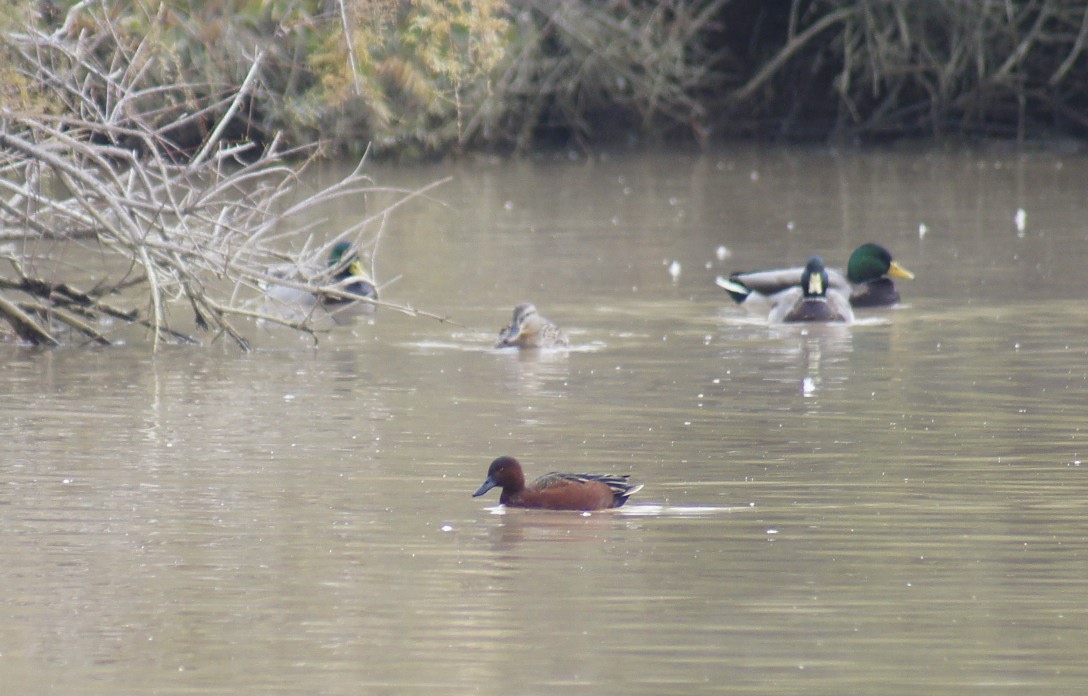
Here is the first Cinnamon Teal I've seen this winter:

And the first Green-Winged Teal:

And the first Northern Shoveler:


At certain spots throughout the Ranch, you can find tidy colonies of Black-Crowned Night Herons. At one point I've seen as many as 11 crammed into one tree. Today there were a half-dozen or so on display, including 1 juvenile. When you've got a big bird in dense foliage, it's hard to get a full and unobscured body shot. While trying to maneuver for a better view, I knocked into a lot of plant growth that was still retaining the night's rainfall. The resultant wet chiding was excellent encouragement for me to stay on the trail. It's probably lucky my camera was unharmed, and I was also lucky not to startle the Herons. Night Herons are such suspicious and grumpy birds. More that most, they're prone to sit hunched up for hours and hours on end. I wonder what they think about...


This sulking juvenile was in some sort of time-out, forced as he was to inhabit his own, separate tree.


Occasionally I'll give in-flight photography a try. It is seldom fruitful for me, but it's definitely an area where I want to improve. Unfortunately, I clipped this poor Egret's wing. I'm glad he can still fly.


After playing paparazzi to the herons and egrets for a while, I wandered back to the northern and sunnier portion of the GWR. The increase in foot traffic and fishermen here means there are fewer of those uncommon and less gregarious birds, but it does mean that those birds you find are more used to people. They'll tolerate a closer approach and You'll usually have a great look at them.

Sometimes, that's not enough, and here's the tricky ID of the day. Given that it's December and most Warblers should be gone, what could this be? Is it a Female Wilson's? Female Yellow Warbler? Immature Yellow Warbler? Fall plumage Wilson's or Yellow? I see little yellow birds like this pretty often, both at the GWR and at the Desert Botanical Garden. For a while I figured them to be either female or immature Yellow Warblers? Nowadays I readily admit that I just don't know. Any and all suggestions, if not identifications are much appreciated.


Find the dullest, most sleepy Hummingbird you can, and it's still a treat to see from any angle (and how they appear certainly does depend on the angle). This male Anna's was putting on quite a show from his proud perch. Like the Anna's I photographed a couple weeks ago, I couldn't quite get that perfect shot where you see the full brilliance of the bird's gorget. I can understand though if he wants to save it for the ladies.


Birding is full of watershed moments. Once you get that first sighting, it seems like the 2nd and 3rd sightings come right after. You might go years without seeing a certain bird, and then all of the sudden you'll get 4 in a week. For me, the most recent synchronicity is with blinking birds. Last week I captured a blinking Ring-Necked Duck, and then photographed a blinking Coot almost immediately afterwards. This male Anna's was in a blinky sort of mood as well, and I have to say it's pretty darn precious when he does it.


Despite my most polite requests and entreaties and pleadings that he turn his head ever so slightly, this haughty Anna's was determined to look west. I do believe that at this point he was just mocking me.


Magnificent though they are, Hummingbirds are not the only splashes of color around the GWR. There has been an incredible expansion in the wild Lovebird population over the last 5 years or so. While they can now be found in nearly every city park across the Phoenix metroplex, The Gilbert Water Ranch was probably the site of one of their first colonies, and they're still a reliable sighting there throughout the year.


A little bit more surprising was this immature Moorhen standing out in the open near the entrance to the Ranch trails. This was only my second sighting of a Moorhen, but if they're this brazen now, I expect there will be many moor in the future.


On the main entrance pond nearby was this sadly single female Ruddy Duck, who may not have moved since I last saw her 3 weeks ago. I can't wait to see some Ruddy ducks in their spring plumage. Is there any other bird whose bill changes colors like that? There wasn't too much color on display here, but you can see why they're in the stiff-tailed duck tribe. 


Once again the Water Ranch provided a great day of birding fun. The female Northern Harrier was still terrorizing the field birds (I didn't even try for a picture), and there were also some Scaups and even a leucistic Say's Phoebe reported in the area. While the drive out is daunting at times, the Ranch is definitely still the premier and preferred birding hotspot in Phoenix.

If you're in the area, Red Mountain Park is just a couple miles north, and it is the reported nesting area for wintering Yellow-Headed Blackbirds (or was a few years ago). I had no such luck today, and in fact it appeared that the entire lake area had been thoroughly conquered by quibbling Coots! I did add a new bird to the ol' Life List though, courtesy of this female (or immature?) Canvasback who had sequestered herself in the middle of the pond. If I'm not mistaken, it's somewhat unusual to see them very far inland during the winter. Success!

Saturday, December 3, 2011

Pretty Birds Close to Home

It is overcast and rainy today, and by all accounts will stay so for the rest of the day. I was planning to go down to the Gilbert Water Ranch today, and also check out a potential Yellow-Headed Blackbird reservoir to which Robert Mortensen made me privy a few days ago. Alas, I already had one Saturday of photography frustrated by overcast weather, so I shall try to go tomorrow instead. In the mean time, I did get some photos at Grenada Park on the way home from work, and this seems as good a rainy day as any to share them.

The sun was out in full on Friday. Even though it's setting by 5:30pm now, I still had a very pleasant hour of photography around the duck ponds and bordering chaparral that Grenada Park provides. I counted over 24 Lovebirds enjoying the romantic sunset, a new personal record for the park.


These two Lovebirds were in the same tree. The first bird was perched near the trunk and sitting contentedly within the shade. The second bird was at the edge of the overhanging canopy, watching the sun's retreat. I know the lighting accounts for a lot of the difference in saturation and color here, but it's still interesting to note the difference of hue created by the lighting, and the bird's actual difference in pigmentation. Looking at the top bird, I'd be inclined to call it Rosy-Faced. Looking at the bottom bird, I'd be more inclined to say Peach-Faced...


The evening also afforded me an opportunity to photograph Yellow-Rumped Warblers that were, for once, not in palm trees. When I spotted this first subject in a distant creosote bush, I suspected my string of bad luck with the Yellow-Rumps was about to be cut.


And so it was that on 12/02/2012, around 4:15 pm, I took my first satisfactory pictures of the western Yellow-Rumped Warbler. The tell-tale yellow flanks and rump are visible, but I especially liked the buffy chin and slight grey on the back of the head. Even in their muted autumn/winter plumage, there's much to appreciate in the Yellow-Rumped Warbler.


It's a grand feeling to come away with some good warbler shots, and it gave me an excellent peace-of- mind as I headed down to the duck ponds. There are several  pairs of American Wigeon that hang around the Grenada ponds and provide a welcome relief to the scores of Mallards and Ring-Necks that patrol the shores. The green and white head of the male Wigeon is pretty fantastic, but I think my favorite attribute is harsh difference between the stippled coloration or the neck, and the rich brown of the breast. It's such a stark contrast. It seems like there are usually liminal areas on the birds, where the different colors mix and overlap a bit. Not so with the fashionable Wigeon!


It's not often I get to see the white belly, and unfortunately my shutter speed was too low to catch the Wigeon stretch in all its glory. But you can see the difference in the transition between the white belly and the brown breast, where the two colors overlap and mix quite nicely. The same goes for the green coloration on the Wigeon's head, as it slowly blends into the back of the bird's neck. The Ring-Necked Duck's ring is almost impossible to see, but the border between the neck and breast of the Wigeon is incredibly defined.


It's always a pleasure to see Pied-Billed Grebes. They remind me of little tug boats.

Wednesday, November 30, 2011

Wednesday's with Audubon, Chapter 1

I received a wonderful present this autumn in the form of John J. Audubon's journals. Compiled into two books and edited by his granddaughter, Maria R. Audubon, this incredible compilation was published in 1897, and provides for a fascinating insight into the life of the great explorer and ornithologist.


The books themselves are pieces of history, and demand a certain reverence and delicacy that is, at times, hard to maintain while adventuring along the Missouri River with J.J. Audubon. The binding of these books is so old that you have to cut the pages apart with a sharp knife as you progress through the stories (every two pages are actually attached on the right margin, so page 13 skips right to page 16 unless you lacerate the right-side margin to reveal pages 14 and 15).


I didn't know they ever bound books this way, but I guess it makes sense. It reminds me of a newspaper, as if they'd print the entire book out on one long sheet of paper, or several long sheets, and then fold them back in on themselves intermittently for a strong, non-adhesive binding. Fascinating!
My aspiration is to read a section each week and reproduce its highlights here every Wednesday, to the best of my ability, such that I can share these incredibly cool stories with all who are interested.


John J. Audubon's life began rather inauspiciously, on an unknown day, in an unknown year, on the French island of Santo Domingo (modern Dominican Republic). Audubon's mother was killed in a slave insurrection soon after his birth, and his father resettled in Nantes, France, where he remarried. With little knowledge of his early childhood, and none about his birth, Audubon's journals actually begin with a description of his father's: "John Audubon, my grandfather, was born and lived at the small village of Sable d'Olhonne, and was by trade a very humble fisherman. He appears to have made up for that want of wealth by the number of his children, twenty-one of whom he raised to man and womanhood...When my father had reached the age of twelve years, his father presented him with a coarse shirt, a stick, his blessing, and urged him to go and seek means for his future support...Some kind whaler or cod-fisherman took him on board as a "Boy"."

Audubon's father slowly grew in strength and skill. He achieved his own command of a fishing vessel at twenty-one, and owned several small crafts by twenty-eight, with which he sailed to the Caribbean, where he plied his trade until he could buy a small estate.  Within ten years, John Woodhouse Audubon was called to serve in the French navy, and he worked for both Rochambeau and Lafayette during the American Revolution,  "The war between England and her child of the West."

By his own account, Audubon took after his father, both in appearance and disposition: "My father and I were of the same height and stature, say about five feet ten inches, erect, and with muscles of steel; his manners were those of a most polished gentleman, for those and his natural understanding had been carefully improved both by observation and self-education. In temper we much resembled each other also, being warm, irascible, and at times violent; but it was like the blast of a hurricane, dreadful for a time, then calm almost instantly returned."


Despite the rather ruff-looking portrait that Audubon provides of his farther, he grew up in exceptional comfort. In fact his first vivid memory from France was of their pet monkey deliberately killing their pet parrot as it squawked for its morning meal: "I was tranquilized, the monkey was forever afterward chained, and Mignonne buried with all the pomp of a cherished lost one."

While Aududon's father insisted that he learn the value of hard work and perseverance from a young age, it was perhaps Audubon's stepmother who won out in the early years: "My stepmother, who was devotedly attached to me (she had no children of her own), far too much for my own good, was desirous that I should be brought up to live and die like a gentleman. She therefore completely spoiled me, hid my faults, boasted to every one of my youthful merits, and worse than all, said frequently in my presence that I was the handsomest boy in France."

It was assumed that Audubon would follow in his fathers footsteps and serve either as an officer in the French military or as an engineer. In addition to his normal schooling, he was afforded private tutors in mathematics, geometry, drawing, geography, and fencing. "My father being mostly absent on duty, my mother suffered me to do as I pleased; it was therefore not to be wondered at that, instead of applying closely to me studies, I preferred associating with boys of my age and disposition, who were more fond of going in search of birds' nests, fishing, or shooting...Thus almost every day, instead of going to school when I ought to have gone, I usually made for the fields, where I spent the the day; my little basket went with me, filled with good eatables, and when I returned home, during either winter or summer, it was replenished with what I called curiosities, such as birds' nests, birds' eggs, curious lichens, flowers of all sorts, and pebbles gathered along the shore of some rivulet."

Thus we can see that curiosity and love for nature beginning to grow in young Audubon, perhaps at the expense of other subjects. "The first time my father returned from sea, my room exhibited quite a show, and on entering it he was so pleased to see my various collections that he complimented me on my taste for such things. When he inquired what else I had done, and I, like a culprit, hung my head, he left me without saying another word."

That's all for this week. Tune in next  Wednesday for the beginning of John J. Audubon's adventures.
In the mean time, super bonus points to whoever can identify this bird engraved on the cover: